About Hypsizygus ulmarius (Bull.) Redhead
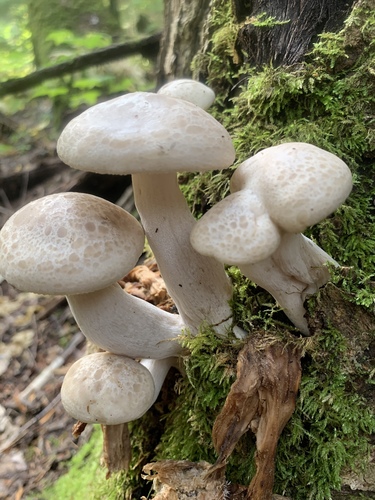
The mushrooms of Hypsizygus ulmarius are white to cream, with relatively uniform color across the entire fruiting body. The stipe grows out perpendicular to the fungus's host tree, then bends vertically to support the cap. The stipe is bare, with no rings or other distinct features, and attaches almost perfectly at the center of the cap. The cap typically measures 6–15 cm (2.4–5.9 in) in diameter, though it may grow larger; it is convex with an incurved margin, and larger caps often become depressed in the center. Caps are uniform and smooth when young, but may develop an aerolate texture as they age. The gills are adnate or only very slightly decurrent, which distinguishes H. ulmarius from the commonly confused Pleurotus species, which have deeply decurrent gills. Fruiting bodies of H. ulmarius most often grow in clusters of 1 to 3, though larger clusters may form on large tree wounds. Cultured H. ulmarius produces both sexual and asexual spores. Asexual arthrospores may be either mononucleate or multinucleate. There is conflicting published data on the size of the sexual basidiospores of H. ulmarius, but Redhead's original species description reports they are usually 5–7 micrometers in diameter, with a shape ranging from subglobose to ellipsoidal. The spore print of this species is white to pale cream. H. ulmarius most commonly grows on elm, box elder (Acer negundo), and beech trees, though it can be found on other tree species as well. It grows high up in wounds or scars on host trees, and is found in temperate forests across North America, Europe, and Asia. Despite its broad range, the species is relatively rare compared to its Pleurotus lookalikes. H. ulmarius is classified as both a saprotroph and a parasite, because it occurs on live trees but it remains unclear whether it feeds on live or dead host tissue. The species causes brown rot in damaged areas of its host trees, but it also has a moderate ability to break down lignin, similar to white rot fungi. It achieves this by producing a complex set of enzymes that break down both cellulose and lignin, including laccase. While brown-rot fungi are not unknown to produce laccase, which is primarily associated with lignin degradation, H. ulmarius's use of this enzyme is fairly uncommon. Its production of brown rot also distinguishes it from Pleurotus species, which are mainly white rot fungi. H. ulmarius is easily grown in culture on a wide variety of media. It can also be cultivated on the same types of substrates used for true oyster mushrooms, including paper, straw, and logs.