About Hypsizygus tessulatus (Bull.) Singer
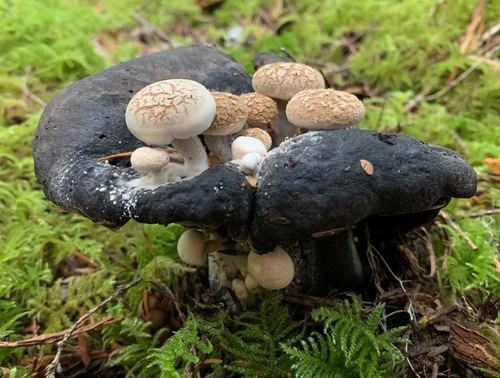
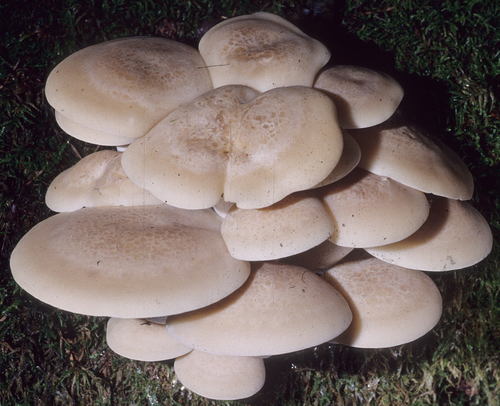
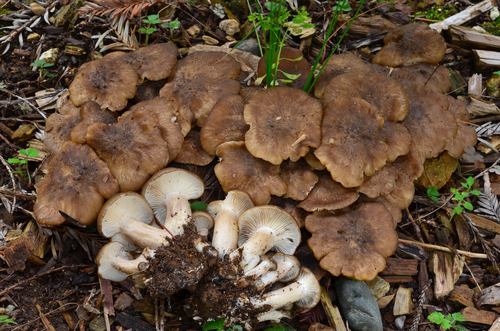
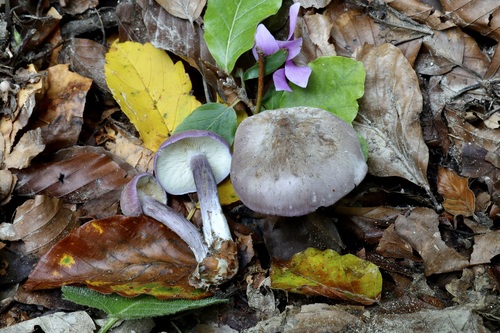
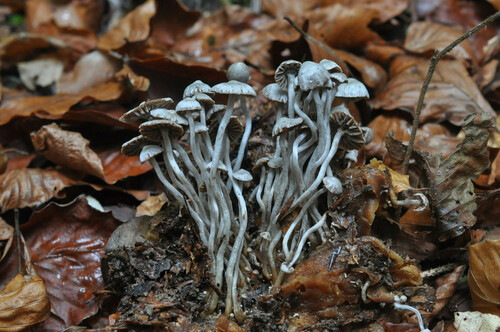
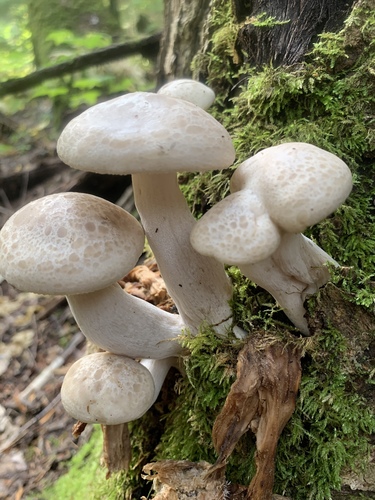
Hypsizygus tessulatus (Bull.) Singer has a cap that ranges in color from white to yellow, measures 5–15 centimetres (2–6 in) across, and starts convex before becoming flat and sunken. Its gills are adnexed to sinuate, fairly closely spaced, whitish when young and turning cream with age. The stem grows up to 11 cm (4+1⁄4 in) long and 3 cm (1+1⁄8 in) wide, and is wider at its base. The flesh is firm and white, with a pungent scent and mild taste, and the spore print is white to buff. This species is native to East Asia and common in northern North America. It grows singly or in scattered groups on hardwood trees, often far above the ground, and is frequently found on beech trees, which is the origin of its common name. Hypsizygus tessulatus is cultivated on a local scale in temperate regions of Europe, North America, and Australia, and sold fresh in supermarkets. Two commercial varieties originate from Japan: Buna-shimeji, the wild type with brown coloration, is also called brown beech mushroom, beech mushroom, and brown clamshell mushroom; Bunapi-shimeji is a white, UV-induced mutant of Buna-shimeji, known as white beech mushroom and white clamshell mushroom. The original strain of this mutant is registered by Hokto Corporation. This mushroom is edible but tough when raw, so it requires cooking to improve its texture and eliminate its bitter taste. When cooked, it has a firm, slightly crunchy texture and a nutty flavor, and cooking also makes it easier to digest. It is commonly added to stir-fried dishes including wild game and seafood, and is also used in soups, stews, and sauces. When cooked on its own, whole shimeji mushrooms—including the stem, with only the very end removed—can be sautéed at high temperature, or slow roasted on low heat with a small amount of butter or cooking oil. Shimeji is also used in soups, nabe, and takikomi gohan.