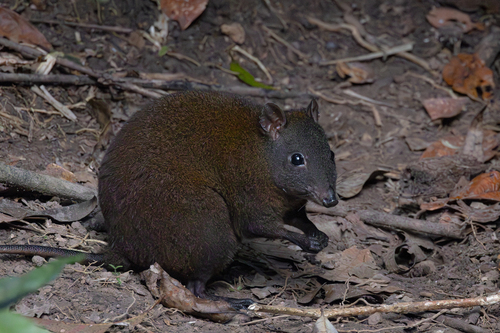
About Hypsiprymnodon moschatus Ramsay, 1876
Hypsiprymnodon moschatus is the smallest species in the macropod order, with an average weight of around 500 grams (18 oz) and a total weight range of 360 to 680 grams (13 to 24 oz). The combined head and body length measures 155 to 270 millimetres (6.1 to 10.6 in). Sexual dimorphism is not easily noticeable in this species, though females may be slightly larger. They have a long black tail that ranges from 125 to 160 mm (4.9 to 6.3 in) in length; the tail has a scaly rather than hairy appearance, and it is proportionally shorter than the combined head and body length. Their ears are also nearly hairless and have a leathery appearance. Most of the body is covered in uniform, deep, rich brown fur with reddish highlights, while the head and lower body parts are somewhat greyish. A steel grey colour on the head grades into the rich brown of the body, and the dark chocolatey fur colour distinguishes this species from other living rat-kangaroos. A white band, ranging from faint to distinct in different individuals, runs from the belly toward the throat. The feet of H. moschatus are blackish, and uniquely among macropods, the hind foot has five toes. This animal gives off a noticeable musky odour. The dentition of this species resembles that of living potoroids, except for the incisor formula that defines the potoroid family, which is I3/1. The dental formula of H. moschatus is I3/2 C1/0 PM1/1 M4/4. Juveniles have two premolars that are replaced when they reach maturity, when a single sectorial premolar erupts. The sequence in which molars and premolars emerge can be used to determine the age of an individual. Hypsiprymnodon moschatus has a fine, delicate skull structure with a narrow, elongate rostrum. It has long nasal bones, and there is a large distance between the canine and premolar teeth. This species only occurs in northeastern Australia. It may be locally common in remaining extensive rainforest areas, and can be found at both high and low elevations. Its distribution range extends from Mount Lee, west of Ingham, Queensland, to Mount Amos, south of Cooktown. It inhabits low altitude rainforests such as those at Cape Tribulation and Mission Beach, as well as the montane habitats of the Carbine, Atherton and Windsor tableland regions. The population density of H. moschatus ranges from 1.40 to 4.50 animals per hectare. A number of parasitic species are associated with H. moschatus; these include internal parasites such as roundworm and tapeworm species, and ectoparasites such as ticks, mites, lice and fleas. Identified mite (Acari) species found on this animal belong to the genera Mesolaelaps and Trichosurolaelaps. Musky rat-kangaroos have been protected from many of the threatening factors that greatly reduced potoroine species, as their rainforest habitat has remained partly secluded and conserved. However, the species remains vulnerable to population fragmentation caused by land clearing, which disrupts the ability to recolonize habitat and increases genetic isolation. This species plays an important role in seed dispersal for the ecology of its tropical rainforest habitat. By carrying fleshy fruits away to eat, or pressing them into the ground as caches, Hypsiprymnodon moschatus improves the chance of successful plant recruitment. This interaction between the mammal and native plants has been compared to similar interactions between plants and seed-dispersing mammals on other continents, such as squirrels and agoutis, and has been proposed as an example of convergent evolution. The lack of size difference between sexes corresponds to limited home ranges for males; the inability of males to range beyond a single female's territory also allows them to pay more attention to competing males for mates. A high level of home range overlap within a local population allows for high population densities.

