About Hypsipetes philippinus (J.R.Forster, 1795)
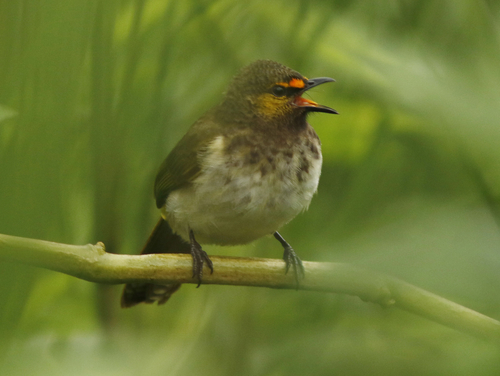
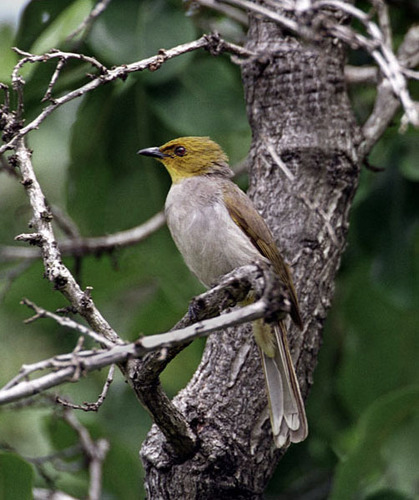
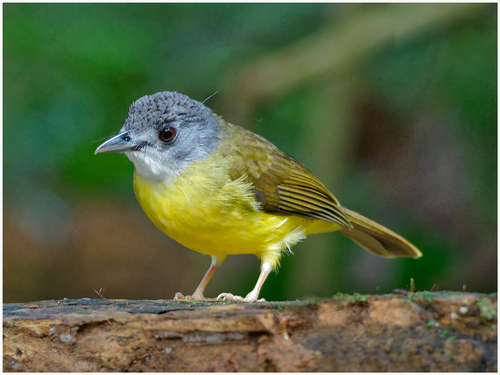
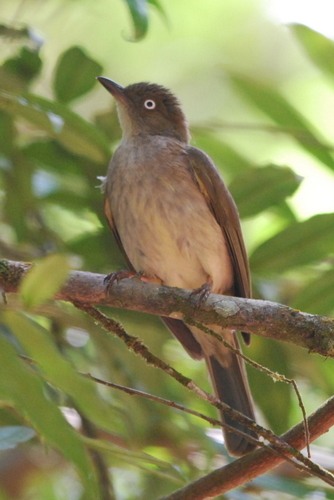
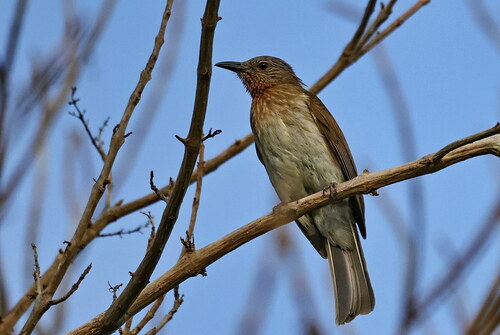
This species, the Philippine bulbul, has the scientific name Hypsipetes philippinus (J.R.Forster, 1795). Ebird describes it as a medium-sized bird found in lowland and montane forest, as well as more open wooded areas. It is dark brown on its upperparts, with a pale belly, an orange-brown throat and chest marked with pale streaking, and a dark head with faint gray streaks. Its bill is fairly long and black. It is similar to the streak-breasted bulbul, but it is smaller, has a shorter bill, a grayish crown, and a warmer orange-brown throat and chest. Its song is made up of short, loud whistled phrases with a slightly metallic quality; it also produces downslurred squeals and chattering. The Philippine bulbul was originally classified in the genus Turdus, then later moved to the genus Ixos. In 2010, it was reclassified to the genus Hypsipetes, because it is very closely related to the black bulbul, the type species of that genus. Until 2010, the Mindoro bulbul, Visayan bulbul and Zamboanga bulbul were all treated as subspecies of the Philippine bulbul. The Philippine bulbul can be distinguished from these other species by its lighter plumage, smaller bill, and different call. Its natural habitat includes tropical moist lowland forest, forest edge, clearings, and coconut groves, found up to 2,000 meters above sea level. It is a common and adaptable bird that persists as long as sufficient forest remains, so the IUCN does not consider it a threatened species. It is a feeding generalist that eats both fruit and insects. Fledglings of the Philippine bulbul have been recorded on Mindanao in late April, but the breeding season appears to be prolonged, as females with ripe ovarian follicles were still found in April and May. Territorial songs can be heard at lower altitudes as late as May; at higher elevations, the birds are silent at this time of year and are presumably engaged in breeding activity. The besra has been recorded preying on young Philippine bulbuls, and the besra or other goshawks may also catch adult birds.