About Hypsipetes amaurotis (Temminck, 1830)
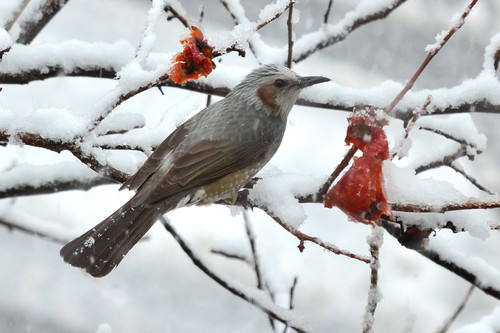
The brown-eared bulbul (Hypsipetes amaurotis (Temminck, 1830)) reaches a length of approximately 28 cm (11 in). It is grayish-brown, with brown cheeks that give the species its common name, and a long tail. Though brown-eared bulbuls prefer forested habitats, they adapt easily to both urban and rural environments. Their noisy squeaking calls are a familiar sound across most areas of Japan. Flocks of these birds produce loud "shreep" and "weesp" calls year-round. One author has described the brown-eared bulbul's song as "one of the most unattractive noises made by any bird".
This species is common across a very large range, which covers the Russian Far East (including Sakhalin), northeastern China, the Korean Peninsula, Japan, and extends south to Taiwan and the Babuyan and Batanes island chains in the northern Philippines. Historically, brown-eared bulbuls were migratory, moving to the southern parts of their range for winter. In recent decades, however, they have taken advantage of changes to crops and farming practices to overwinter in areas further north than they previously could. Most brown-eared bulbuls still move south in winter, and often gather into huge flocks during migration. In some areas of Japan, they are considered agricultural pests: they may invade orchards and damage crops including cabbages, cauliflowers and spinach.