About Hypselodoris tryoni (Garrett, 1873)
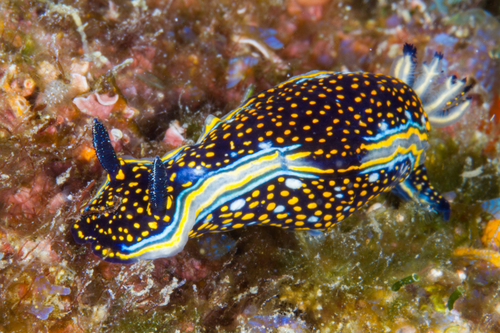
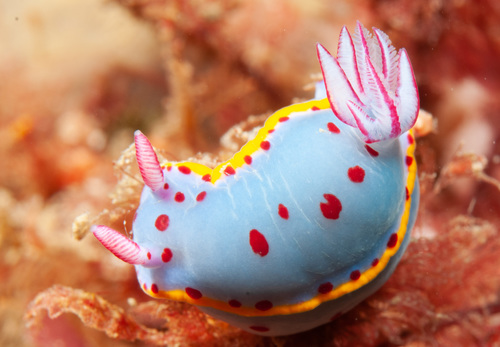
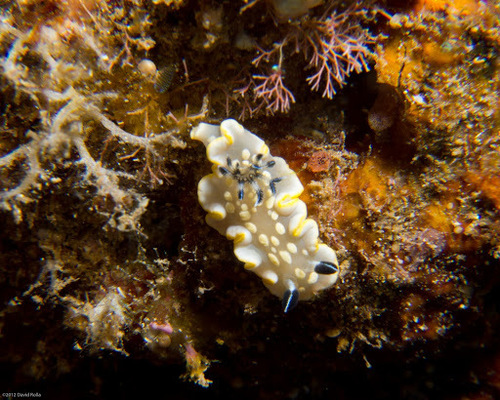
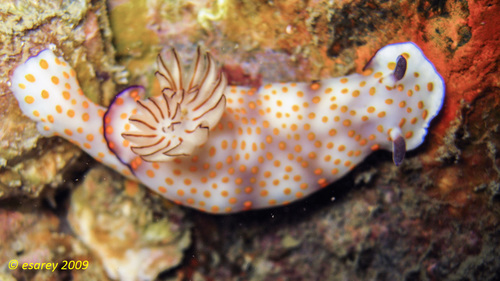
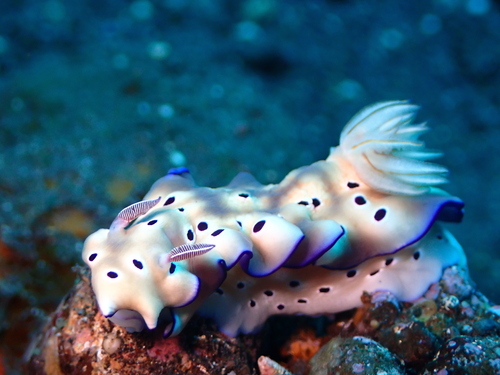
Hypselodoris tryoni (Garrett, 1873) has a brown body and a white foot. Its body and upper dorsum are covered in purple spots ringed with white or light brown. The gills are usually translucent white or light brown, while the rhinophores are brown to dark brown and marked with circular white lines. A thin blue or purple line runs along the edge of its mantle. Individual specimens of this species show some variation in coloration. This species looks similar to Goniobranchus geminus, Goniobranchus kuniei, and Goniobranchus leopardus, but it does not have the wide purple line on the mantle edge that those three species have. Goniobranchus species also typically have a lower, more rounded body shape than Hypselodoris tryoni. Hypselodoris tryoni is known to display trailing behaviour, where up to four individuals will follow one another very closely, often touching. The cause of this behaviour remains unknown. This species can reach at least 60 millimetres in length, and individuals have been observed raising and lowering their heads while crawling. This species was first described from the Society Islands, and it has been reported to occur widely across the tropical Western Pacific Ocean, ranging from Australia to the Philippines. Like many other species in the family Chromodorididae, Hypselodoris tryoni (also referred to as Risbecia tryoni) feeds on sponges, and has specifically been observed feeding on sponges from the family Dysidea. When feeding, individuals are sometimes accompanied by groups of the shrimp Periclimenes imperator, in what appears to be a commensal relationship.