About Hypselodoris maculosa (Pease, 1871)
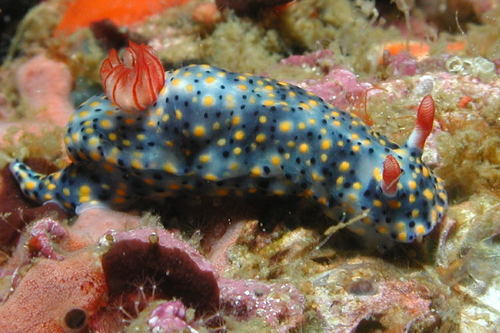
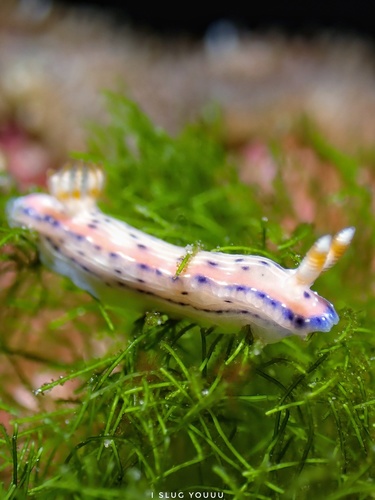
Hypselodoris maculosa is a species of nudibranch with a cream-colored body. Its mantle has a brown margin, and there are four longitudinal white lines running along its dorsum. Between these white lines, slightly elongated dark purple-black spots are arranged in single irregular rows. The brown margin is partially edged in white, and extends into the back in patches, with clusters of dark spots inside these patches. The anterior end of the mantle and the area behind the gills are light purple, marked with both white and dark purple spots. The rhinophores are white, with a broad brown band located just above the start of the lamellae, and a narrow orange band above the brown band. The gill leaves are brown at their base, transition to white, and end in orange tips. This species can be told apart from Hypselodoris decorata by having two rings on the rhinophores rather than three, and by differences in colouration details. Several other species, including Hypselodoris yarae, Hypselodoris paradisa, and Hypselodoris juniperae, were previously confused with Hypselodoris maculosa. This nudibranch can grow to a total length of at least 32 millimetres, and has been observed feeding on grey sponges belonging to the genus Euryspongia. Hypselodoris maculosa was originally described from specimens collected in Tahiti. It was once thought to have a wide distribution across the tropical Indo-Pacific Ocean, and to show considerable variation in colour pattern. A study that used DNA sequencing and more careful comparison of morphological differences found that many of these recorded colour variations actually belong to separate species.