About Hypselodoris infucata (Rüppell & Leuckart, 1830)
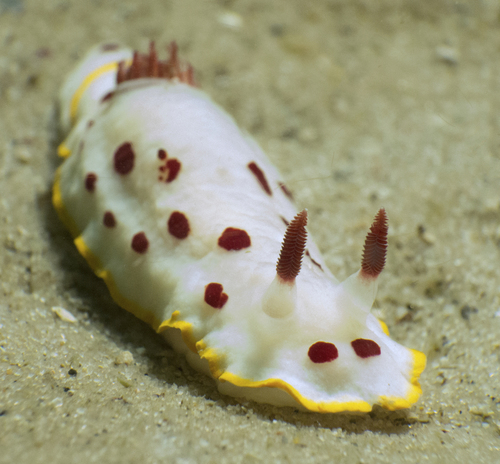
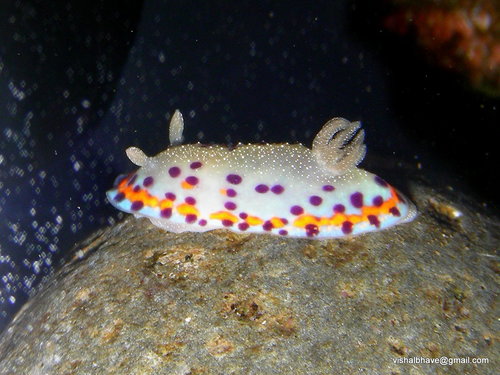
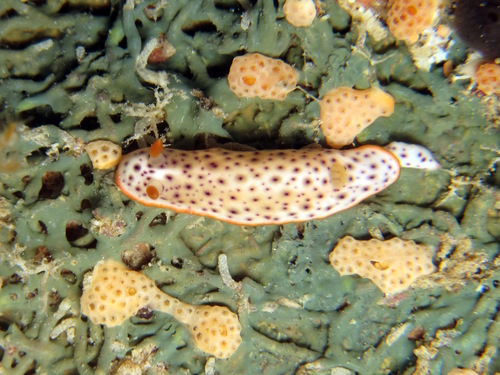
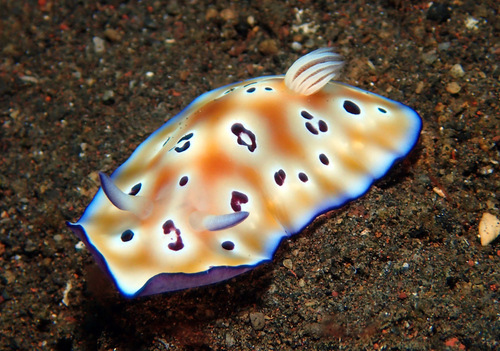
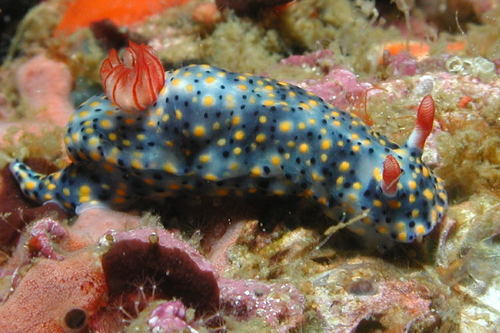
Hypselodoris infucata has a translucent white body with surface pigmentation consisting of grey-blue blotches, large yellow spots, and small black spots. Its gills are white, with a single line of red pigment on the outer surfaces. The rhinophores are opaque white, with red edges along the lamellae and a red line at the front of the club. This species can grow to a total length of at least 50 millimeters. It is most easily distinguished from three similar species — Hypselodoris kanga, Hypselodoris roo, and Hypselodoris confetti — by a difference in gill structure: those three species all have gills with an outer face that forms a triangle from two edges. This nudibranch was originally described from specimens collected in the Red Sea. It can be found from the Red Sea and western Indian Ocean east all the way to the Hawaiian Islands, occurring throughout the tropical Indo-West Pacific. The species is also now present in the Mediterranean Sea, having invaded the region as a Lessepsian migrant through the Suez Canal.