About Hypselodoris iba Gosliner & R.F.Johnson, 2018
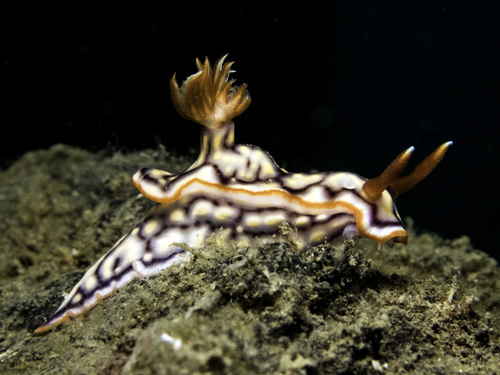
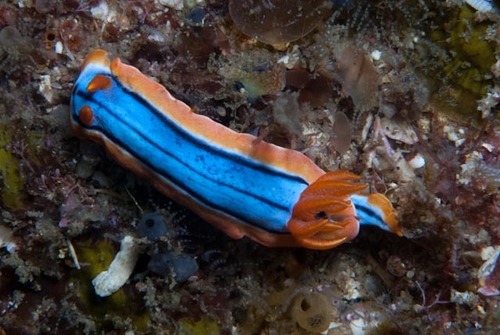
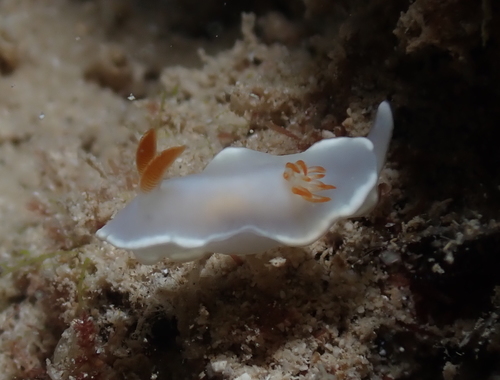
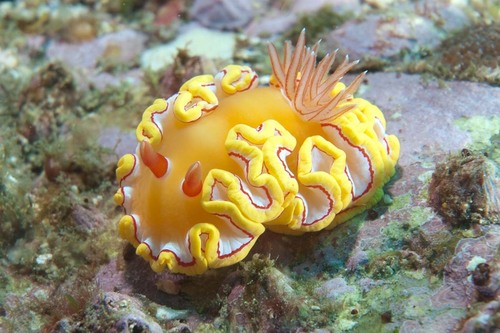
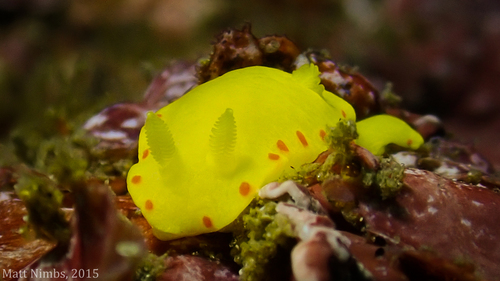
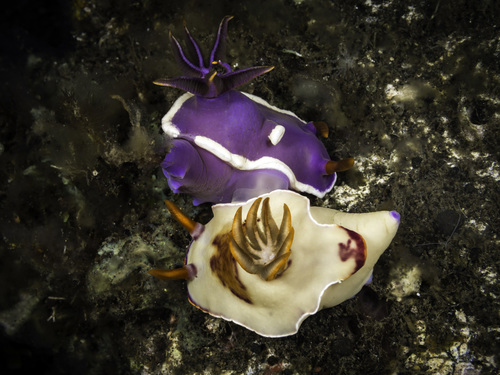
Hypselodoris iba was previously confused with Hypselodoris bullocki, but DNA sequencing indicates it is a mimic of this species rather than a close relative. This species displays a range of distinct colour forms. The most common form has a violet, semi-translucent body with a bright, opaque white margin along the edge of the mantle. The violet body colouration can be entirely absent (replaced by milky white) or only present as a more intensely coloured inner border to the mantle. In these paler colour forms, there is usually a brown patch on the middle of the back, bordered by violet. The gills are pale at their base and transition to orange or brown towards their tips. The rhinophores have orange or brown clubs, and typically have purple bases. A key trait that separates Hypselodoris iba from similarly coloured species in the Hypselodoris bullocki clade is that the section of mantle behind the gills narrows quite abruptly, and holds a concentration of subcutaneous defensive glands. This species can grow to a total length of at least 70 mm. This nudibranch was first described from a specimen collected at 35 metres (115 feet) depth at Aphol’s Reef, Tingloy, Maricaban Island, Batangas, Philippines, at coordinates 13.6586°N 120.90129°E. It has also been reported from Indonesia.