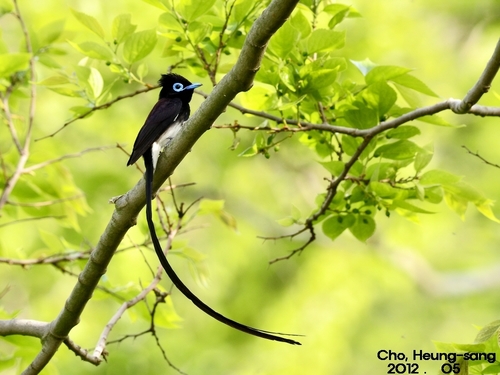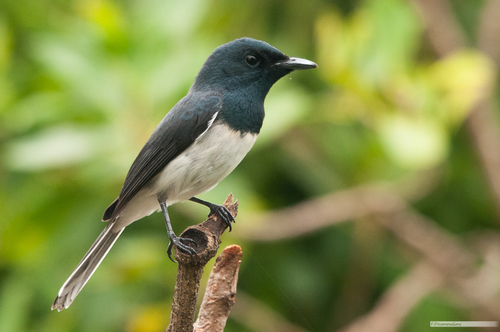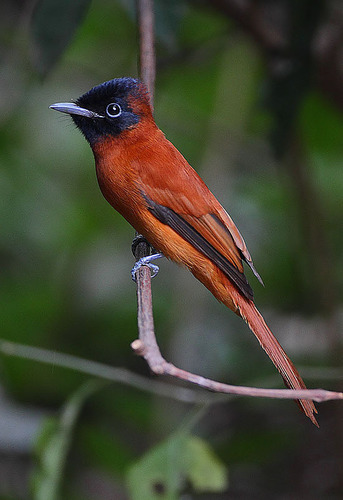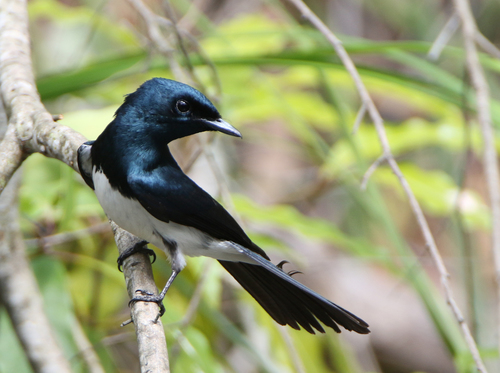
About Hypothymis azurea puella (Wallace, 1863)
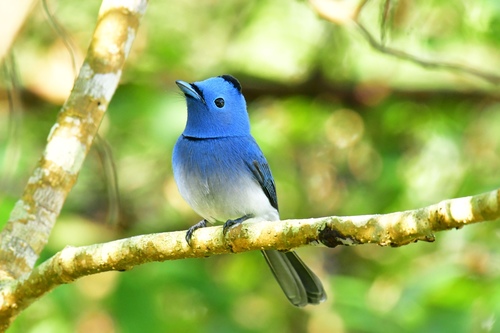
The adult male black-naped monarch (Hypothymis azurea) is approximately 16 cm long. It is primarily pale azure blue, with the exception of a whitish lower belly, and has a black nape and a narrow black gorget. Females are duller in color, lack the black markings, and have grey-brown wings and back. Several geographically separated breeding populations differ in the extent and shade of their markings. On the Indian peninsula, the subspecies H. a. styani (which includes H. a. sykesi described by Stuart Baker) has males with very distinct black markings and a whitish abdomen. Males of the Sri Lankan subspecies H. a. ceylonensis lack the black nape and gorget, and their blue shade is more purplish. The Andaman Islands subspecies H. a. tytleri has blue grey underparts. The Car Nicobar Island form H. a. idiochroa has a greyish white belly, while H. a. nicobarica from the southern Nicobars has a smaller and finer bill. The gape color ranges from yellowish to green. The call of the black-naped monarch is a sharp, abrupt skrip. The black-naped monarch breeds across tropical southern Asia, from Iran and Sri Lanka east to Indonesia and the Philippines. This species typically inhabits thick forests and other well-wooded areas. In India, the main breeding season occurs in summer, from May to July. Females build cup-shaped nests placed in the fork of a tree, decorated with spider-egg cases. Nests are lined with webbing filaments and fungi from the genus Marasmius, which produce antibiotics that may protect nestlings from infection. The male guards the nest during construction. A typical clutch contains two to three eggs. Both parents incubate the eggs and feed the hatchlings, which emerge after approximately 12 days. The black-naped monarch has short legs, and sits very upright when perched prominently, similar to a shrike. It is insectivorous, and often hunts by flycatching. When alarmed or alert, it raises its nape feathers into a pointed crest. It joins mixed-species foraging flocks, and is among the most common members of these flocks in the Western Ghats. It is active in the understory of forest canopies. A study in Sri Lanka found that human disturbance causes black-naped monarchs to retreat around 75 meters from disturbed habitat edges. While most individuals are permanent residents, local seasonal movements have been recorded. The webs of large spiders such as Nephila maculata have been known to trap black-naped monarchs. An astrovirus, previously not recorded in passerines, has been detected in a black-naped monarch in Cambodia. The feather mite Proterothrix hypothymis (Pterodectinae: Protophyllodidae) has been documented from black-naped monarchs in Vietnam.