About Hyporthodus niveatus (Valenciennes, 1828)
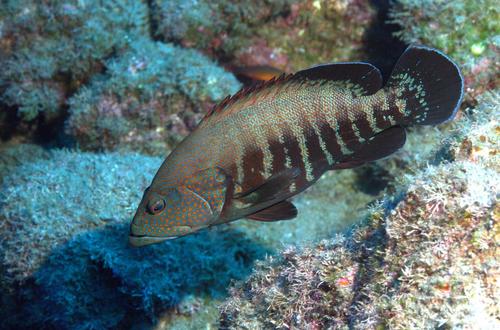
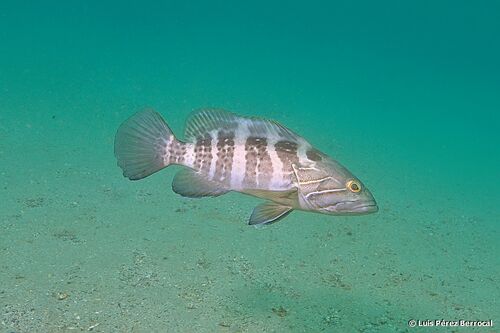
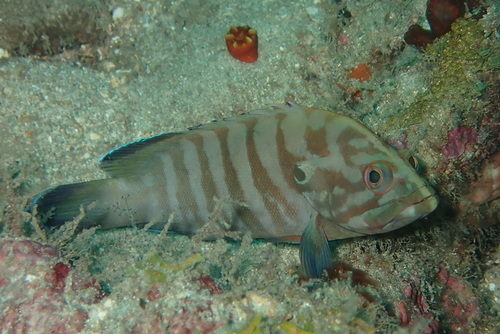
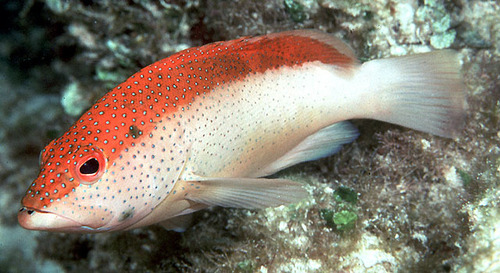
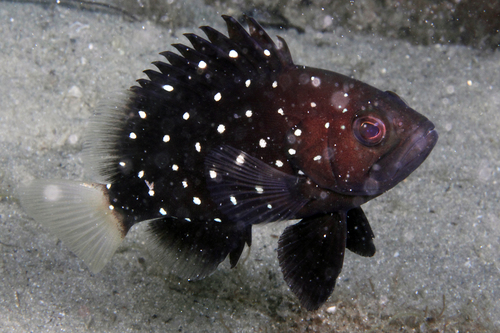
The snowy grouper, Hyporthodus niveatus, has a robust, compressed, oval-shaped body that reaches its maximum depth at the origin of the dorsal fin. Its standard length is between 2.4 and 2.8 times the depth of its body. The preopercle has a serrated edge, with enlarged serrations at its angle; there is also often an upwards-bent spine covered in skin on the lower edge of the preopercle, immediately in front of the angle. The upper edge of the gill cover is distinctly convex. The dorsal fin contains 11 spines and 13 to 15 soft rays, while the anal fin contains 3 spines and 9 soft rays. The membranes between the dorsal fin spines have deep notches. The rear margin of the caudal fin is convex in juveniles with a standard length less than 30 centimetres (12 in), and straight or concave in adult fish. Adult snowy groupers are overall dark brown with a black margin along the spiny section of the dorsal fin. Juveniles are also dark brown, marked with distinct white spots arranged in vertical rows on the back of the head and the body; these spots extend onto the dorsal fin. Like adults, juveniles have a black margin on the spiny section of the dorsal fin, while their caudal and pectoral fins range from yellow to clear. There is a deep black, saddle-shaped mark on the upper part of the caudal fin base that extends underneath the lateral line. This species reaches a maximum published total length of 122 centimetres (48 in), though individuals are more commonly around 60 centimetres (24 in), and has a maximum published weight of 30 kilograms (66 lb).
Snowy grouper are distributed across the western Atlantic Ocean. They occur around Bermuda, and along the eastern coast of the United States from Virginia south into the Gulf of Mexico and the Caribbean Sea. Their range extends along the coasts of Central America and South America, from Mexico south to the Valdes Peninsula in Argentina. The species has also been recorded as far north as Massachusetts.
Snowy grouper live at depths between 10 and 525 metres (33 and 1,722 ft) over rock substrates in offshore waters, and are most abundant at depths between 100 and 200 metres (330 and 660 ft). Juvenile snowy grouper live in shallower coastal waters, and are frequently found along the northeastern coast of the United States. Like most groupers, this species is predatory; recorded prey for adults includes fish, gastropods, cephalopods, and brachyuran crustaceans. Snowy grouper are protogynous hermaphrodites and form spawning aggregations. Females reach sexual maturity between 3 and 5 years old, at a total length of 45.1 to 57.5 centimetres (17.8 to 22.6 in), and transition to male 3 to 4 years after reaching sexual maturity as females. Off the coast of North America, this species spawns from May to June, and a single female can lay more than 2 million eggs in one spawning season.