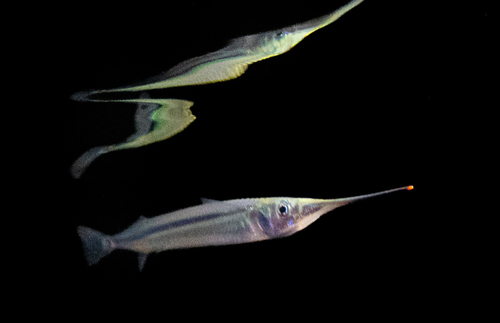
About Hyporhamphus ihi Phillipps, 1932
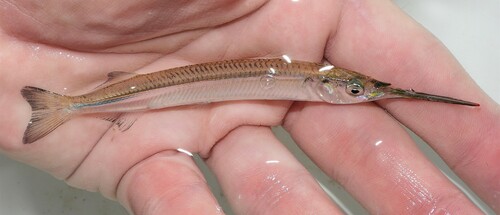
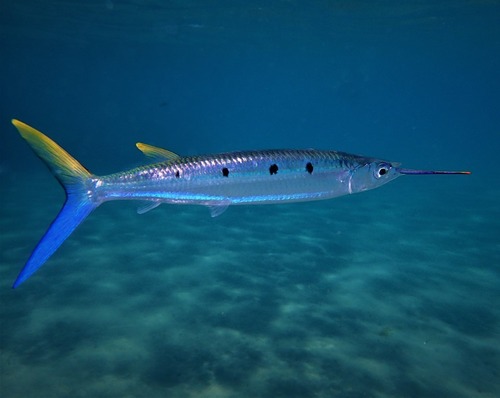
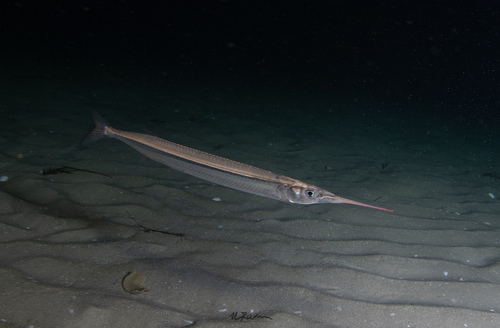
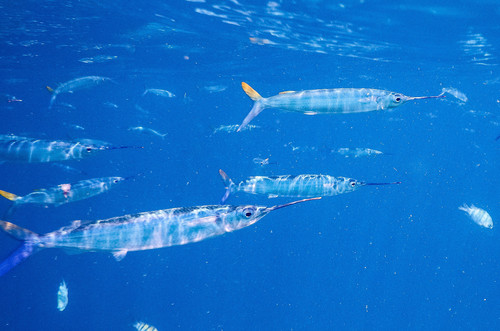
This species of garfish has unusual body shape with distinct features: an elongated, slender body and a very long lower jaw. It typically grows to around 22 centimetres (8.7 inches). Its colouring provides camouflage: the upper body is greenish blue with brown flecks, while the belly and underbody are silver-white. As documented by Montgomery and Saunders, the fish can actively control its coloration by expanding or reducing the pigment in its dorsal melanophores. A long silver stripe runs from the top of the pectoral fin base down to the tail. The pectoral, dorsal, pelvic, and caudal fins are dusky, and the anal fin is pale. The pectoral fin enables the fish to turn left or right and supports overall body stability. The dorsal fin is positioned far back on the body, helping the garfish make sharp turns and stabilise rolling. Unlike most fish, this garfish's dorsal fin has no spines; it is soft instead, and cartilage veins provide rigidity when needed. The pelvic fin assists with quick stops, general stability, diving into deeper water, and rising back to the surface. The caudal fin, or tail, is the main fin that propels the fish through water. This garfish has a forked caudal fin with a large lower lobe, a structure called a hypocercal tail. The anal fin, located at the back of the body, adds extra stability while swimming. Its most distinctive feature is its long lower jaw, which has an orange tip. The upper jaw is typically longer than it is wide, and the lower jaw is usually longer than the entire head; this structure lets the garfish detect vibrations from prey. Because the mouth sits far back from the front tip of the body, it is held in a superior position that makes the garfish well adapted for surface feeding. The elongated jaw acts as a sensory organ to detect prey. This garfish also has two to three rows of tricuspid teeth in both the upper and lower jaw. These teeth are present on both the premaxillae (small cranial bones at the very tip of the upper jaw) and the dentaries (the anterior tooth-bearing bone of the lower jaw). This garfish species is endemic to New Zealand, meaning it is only found there; the closely related southern garfish, H. melanochir, is found in Australia. Within New Zealand, the species occurs all around the country, including the Chatham Islands in the southwest Pacific. It is most common in the northern and central inshore areas of New Zealand. It occupies inshore waters down to depths of a few meters, living in sheltered gulfs, bays, and larger estuaries, mostly around seagrass meadows, shallow waters, and over shallow reefs. Even though the species is widespread, it is uncommon, and its total abundance is hard to estimate. This difficulty is due to its localised schooling behaviour. During the daytime, these garfish are usually found in the open ocean, staying close to the water surface to avoid detection. In the evening, they migrate into harbours and estuaries. The full life cycle of this New Zealand garfish is not well understood in detail, but it may be similar to that of its close relative, the Australian southern garfish (H. melanochir). We do know that this New Zealand species matures at a length of 22 cm (8.7 in), reaches a maximum length of 40 cm (16 in), and has a maximum age of less than 10 years. It spawns from late spring to early summer, in shallow bays. After spawning, eggs sink to the seafloor and stick to vegetation. Larvae that hatch from these eggs can be collected in coastal plankton surveys. It is suspected that the eggs of this garfish have less variability than the eggs of many other small pelagic fish. This trait leads to the formation of localised populations, which are vulnerable to local depletion.