About Hypopyra vespertilio Fabricius, 1787
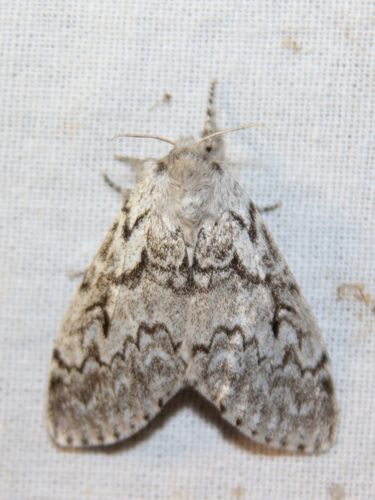
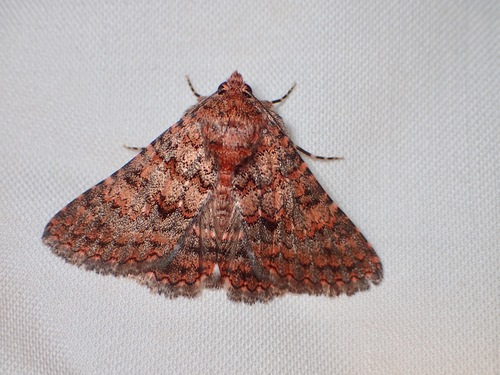
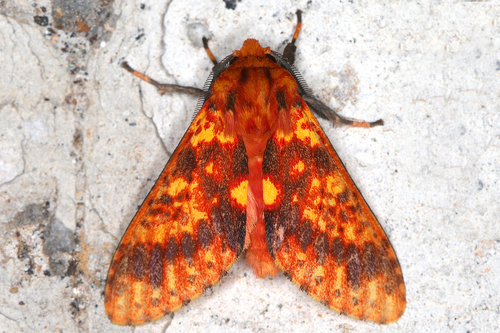
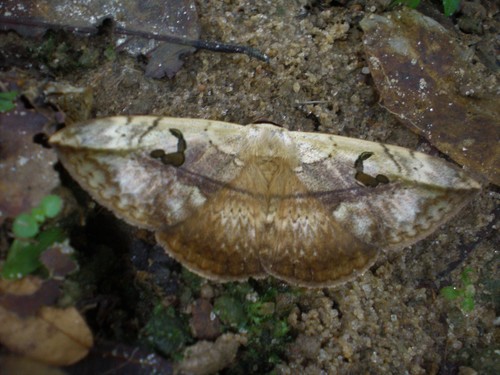
This species is Hypopyra vespertilio, first described by Fabricius in 1787. Males have a wingspan of 74–90 mm, while females have a wingspan of 72–104 mm. Males have minutely fasciculate antennae, and an erectile tuft of long hair grows from the femur-tibial joint of their forelegs. In this species, the tibia and hind tarsi are not fringed with long hair, and the ventral side of the hindwings is not covered in long woolly hair. The wings are grey, suffused with a light fuscous brown tint. On the forewings, the stigma is usually reduced to one or two spots on the discocellulars. The antemedial line curves outward below the costa, then runs obliquely to the inner margin. A double postmedial line is present, angled below the costa; the postmedial line itself is crenulate. The hindwings are fuscous brown, with oblique antemedial lines. The medial and submarginal lines of the hindwings are crenulate, and the inner margin is crimson. The darkest morph is the nominate vespertilio form: males of this form are dark brown, with the costal and outer areas of the forewing suffused with grey and olive, and the stigma is the most developed; females of this form are much paler and greyer. Adult Hypopyra vespertilio have been recorded as fruit-piercers. The larvae feed on Albizia, Acacia, and Wisteria species, and possibly feed on Camellia species. Larvae are pale grey in color.