About Hypopterygium didictyon Müll.Hal.
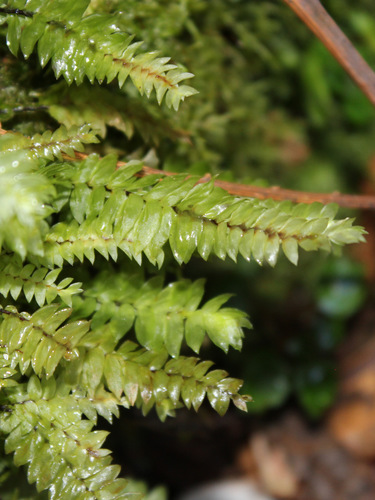
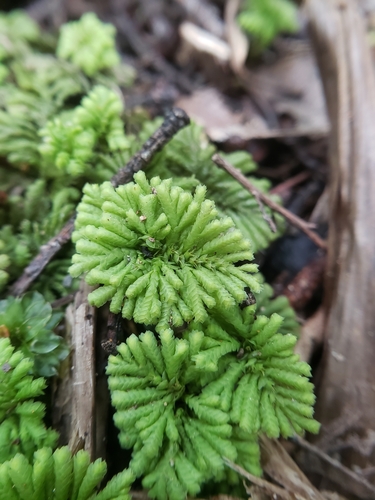
Hypopterygium didictyon Müll.Hal. is a species of moss that typically forms dense clumps. Its fronds have a glaucous, whitish-green appearance. Leaves are arranged in three distinct ranks on most of the frond: two lateral rows on the branches, and one smaller row of underleaves beneath. The basal portion of the frond has leaves arranged in eight ranks, while the upper portion of the frond has leaves arranged in three ranks. Its leaves are oblong to oval in shape, typically 0.5-2.0 mm long and 0.2-1.5 mm wide, with either smooth or serrated margins.
The genus name Hypopterygium comes from the Greek words hypo (meaning under) and pteryga (meaning wing), which refers to the wing-like underleaf structures called amphigastria found on the underside of the genus's branches. H. didictyon is strictly dioicous: it has separate male and female individual plants, both of which are required for sexual reproduction. In addition to reproducing sexually via spores, H. didictyon can spread locally through vegetative fragments and gemmae, which are small asexual reproductive structures.
H. didictyon is a common moss in Tasmania, easily identified by its glaucous whitish-green appearance and distinct leaf arrangement. It is sometimes confused with H. tamarisci, a rarer moss species found mainly in northern Tasmania. While the two species share visible similarities, H. tamarisci can be distinguished from H. didictyon primarily by microscopic features. H. didictyon fronds have eight ranks of leaves at the base, which transition to three ranks at the upper distal portion of the frond. Its leaves are oblong to oval, measuring 0.5 to 2.0 mm long and 0.2 to 1.5 mm wide. Microscopically, H. didictyon can be told apart by its axillary hairs: these have linear or short-linear terminal cells, which are often covered with a white substance that appears as white dots when viewed under a hand lens. By contrast, H. tamarisci has axillary hairs with bulb-shaped terminal cells, and its basal frond leaves are arranged in three ranks.
H. didictyon grows in humid environments, most often on soil, rocks, rotting logs, and tree trunks within forests and scrubby woodlands, particularly near streams. This species is found in New South Wales, Victoria, and Tasmania in Australia, and it is rarely encountered in South Australia. It typically grows at elevations up to 1660 m. H. didictyon is also present in New Zealand, the Auckland Islands, Campbell Island, Chatham Island, and parts of southern South America.
The current distribution of H. didictyon suggests a Gondwanan origin. Its populations were once connected before the break-up of the Palaeo-Austral floristic region around 82 million years ago, which resulted in its current isolated geographic range. Although long-range spore dispersal via westerly winds has been proposed as an alternative explanation for this range, this scenario is considered unlikely. This is due to the species' dioicous nature (requiring separate male and female plants to reproduce) and its lack of specialized asexual reproduction mechanisms. The current distribution of H. didictyon strongly supports a Gondwanan origin over long-distance dispersal.