About Hypoplectrus indigo (Poey, 1851)
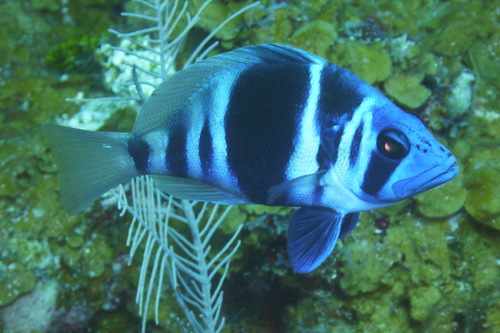
Hypoplectrus indigo (Poey, 1851) has a deep, highly laterally compressed body and head, with a straight forehead, a rather short snout, and a protrusible upper jaw. Its preoperculum is angular, with serrations along its edge and a number of small forward-pointing spines on its lower margin near the angle. The continuous dorsal fin has ten spines and 14 to 17 soft rays. It has long pelvic fins that extend to or beyond the anus, and the caudal fin is slightly forked. The body and fins are dark blue, with a pattern of seven dark blue-black vertical bars across the head and body. The details of the patterning and the intensity of the blue background colour on the body and fins vary between individuals; some fish have narrow black stripes running along the upper and lower margins of the caudal fin. This species reaches a maximum recorded total length of 14.3 centimetres (5.6 in). Hypoplectrus indigo is native to the western Atlantic Ocean. Its range extends from the Bahamas in the north, through the Gulf of Mexico along the Florida Keys, and from Tuxpan, Mexico and the northern Yucatan Peninsula to northwestern Cuba. In the Caribbean Sea, it has been recorded throughout the Antilles as far south as Tobago. It also occurs along the mainland coasts of Central and South America from Mexico to Mamitupo, Panama, and among the offshore islands of Venezuela. Hypoplectrus indigo is a solitary species that lives on coral reefs at depths of 3 to 45 metres (9.8 to 147.6 ft). All species in the genus Hypoplectrus are synchronous hermaphrodites, and are able to switch between "male" and "female" roles when spawning. The colour pattern of this species bears a slight resemblance to that of blue species in the genus Chromis, and it has been suggested that the indigo hamlet is an aggressive mimic of either the blue chromis (C. cyaneus) or C. insolata. However, neither Chromis species strongly resembles H. indigo, due to the latter's darker blue-black bars, and other researchers do not support this hypothesis. These fish stay close to the seabed and defend small territories on or near reefs. They are wary but can be curious: when approached, they often retreat a short distance, but then frequently return and approach stationary divers. This is a carnivorous species that feeds on other fishes and mobile benthic crustaceans.