About Hypopitys monotropa Crantz
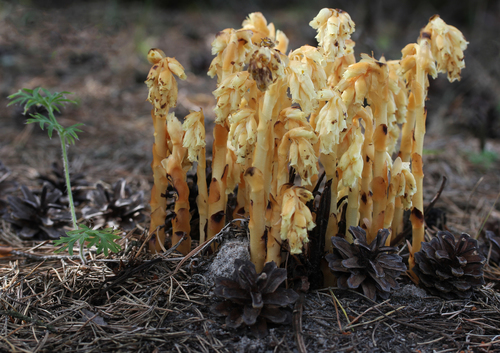
Hypopitys monotropa Crantz (also referenced as Monotropa hypopitys or M. hypopitys in this text) is a fleshy dicot that reaches 10–35 cm in height. It has no true stems; the only structures that emerge above ground are unbranched, adventitious inflorescences that are developmentally similar to adventitious roots. Its bracts are scale-like structures 5–10 mm long that cover most of the inflorescence. It produces cosexual flowers that are pendulous when young, and become erect as they mature into a capsule fruit. Flowers measure 9–12 mm long, and grow in clusters of 1 to 11 at the apex of a raceme inflorescence. Its seeds are extremely small, weighing only 0.000003 grams. This species has multiple color morphs, including yellow, red, and yellowish-white. It is often mistaken for a fungus because of its unusual fungus-like physical traits. Hypopitys monotropa is the most widely distributed member of the subfamily Monotropoideae. While it is native to North America, its range also extends to India, China, Pakistan, Russia, Europe, and Mexico. Within the United States, this mycotrophic species in the heath family Ericaceae is most common in western mixed coniferous forests. The distribution of Hypopitys monotropa is shaped by the distribution of its host, specifically fungi in the genus Tricholoma. The flowering phenology of Hypopitys monotropa generally falls between April and December, and varies based on geographic location and flower morph. Its two dominant color forms, red and yellow, have non-overlapping reproductive timelines: the yellow form blooms in mid-summer, while the red morph flowers in the fall. Both color forms are self-compatible, but the yellow form has higher rates of autogamous reproduction. Pollinator diversity in the Monotropa genus is low, with bumblebees acting as the main pollen dispersal agent. The red and yellow morphs also have distinct floral structures. The red form exhibits approach herkogamy, while the yellow form lacks the spatial separation of reproductive structures that defines herkogamy.