About Hypopachus variolosus (Cope, 1866)
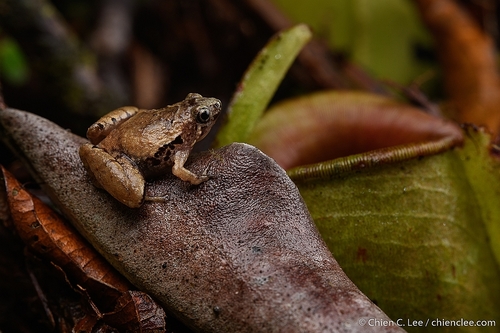
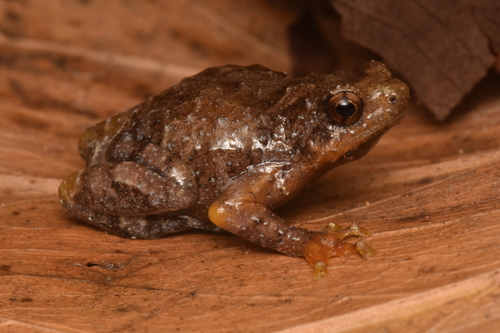
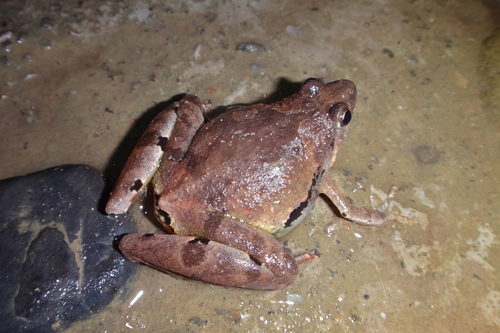
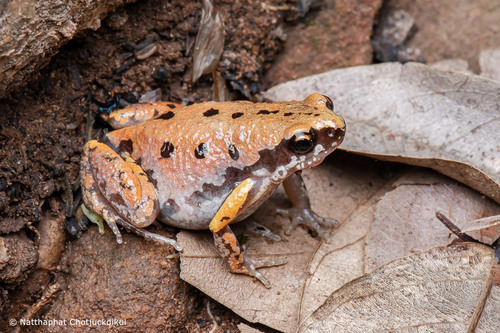
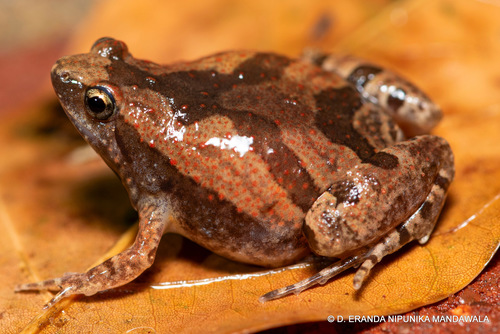
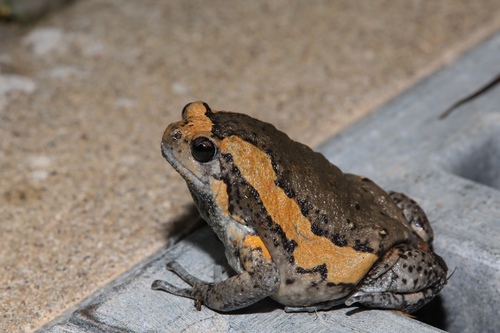
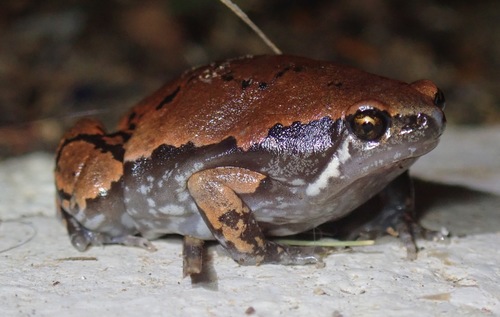
The sheep frog, Hypopachus variolosus, is a relatively small frog, measuring 2.5 to 3.8 cm in total length, with only rare individuals exceeding 4 cm. Males average 3.3 cm and females average 3.8 cm. This species ranges through parts of Central America and Mexico, generally found at lower elevations in coastal areas below 1600 m, and reaches its northernmost limit in far southern Texas, United States. On the Pacific coast, it occurs from northwest Costa Rica, into western Nicaragua, north through western Mexico including the Balsas basin, into Sinaloa, and adjacent areas of extreme southern Sonora and Chihuahua. In Honduras and Guatemala, it ranges across the continent to the Atlantic (Caribbean Sea) coast, north into Belize and throughout the Yucatán Peninsula, up the coast to Nuevo León and Tamaulipas, Mexico, and adjacent areas of southern Texas, US. Several areas within its range, such as southern Belize and northern Sinaloa, lack records, which suggests possible gaps in its known distribution. Conversely, relatively informal records available on internet websites suggest the range extends significantly further into interior regions of southern Mexico than previously documented. In the United States, it occurs on the southern coast of Texas in at least 16 counties, from the lower Rio Grande Valley northward as far as Goliad County north of Corpus Christi. Some older maps indicate a distributional gap in northern Tamaulipas, Mexico, which would suggest the Texas population is isolated from populations in southern Tamaulipas and Nuevo León. However, a few sparse records collected in recent years have filled portions of that gap. Sheep frogs are diet specialists, feeding largely on termites and ants (Hymenoptera), although some minute flies (Diptera) and other insects are occasionally consumed as well. Hypopachus variolosus is known to occur in a variety of habitats, most frequently reported from semiarid thornscrub and savanna environments. It also occurs in drier open woodlands, as well as more humid canyons, basins, foothills and premontane forest up to 1000–1200 meters, with a maximum elevation of approximately 1600 m. It also occupies disturbed areas such as pasturelands, irrigation ditches, and vacant lots. One author has recorded that it is absent from undisturbed moist lowland forest in southern Mexico and Central America. In Texas, it is restricted to the semiarid thornscrub and grasslands of the Tamaulipan mezquital ecoregion. Sheep frogs are secretive and largely fossorial. They are known to live in the cavities of hollowed root systems of trees and shrubs, mammal burrows, and pack rat nests. They are capable of burrowing backwards with their hind feet into loose soils, staying just below the surface during wet periods, and digging as deep as one meter during dry seasons. They emerge after heavy rains to breed and occasionally forage at night, and may be found under rocks, logs, fallen palm trees, and other surface debris while soils remain wet. Sheep frogs deposit their eggs between March and September or October. Emergence and mating is typically stimulated by heavy rain, or occasionally by the irrigation of fields. Males often call while freely floating on the surface of shallow pools. The call is a sheep-like bleat about two to three seconds in duration. Amplexus is axillary, and eggs are deposited in the water, floating at the surface in loosely attached rafts. Typically, although not exclusively, eggs are deposited in ephemeral pools of rainwater, but they are also laid in ponds, marshes, ditches, and cattle tanks. Clutches of about 700 eggs have been reported, and these eggs hatch within 12 to 24 hours. The tadpoles are brownish with faint markings on the belly, and some individuals exhibit a mid-dorsal stripe. Tadpoles grow up to 2.7-3.5 cm in total length. Metamorphosis occurs after about one month, and newly metamorphosed froglets measure 1-1.6 cm in snout to vent length.