About Hypomyces chrysospermus Tul. & C.Tul.
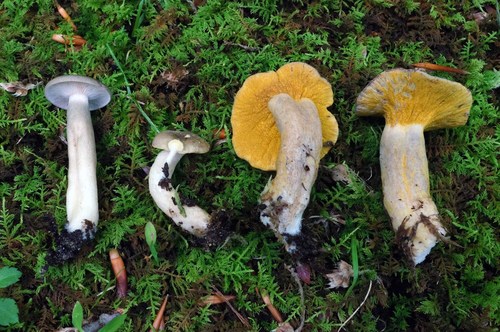
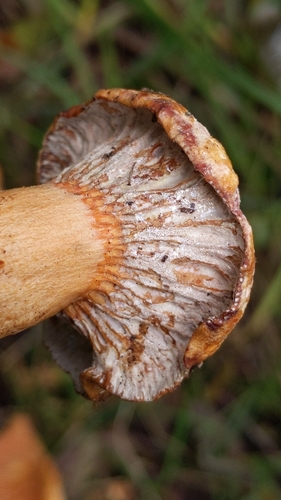
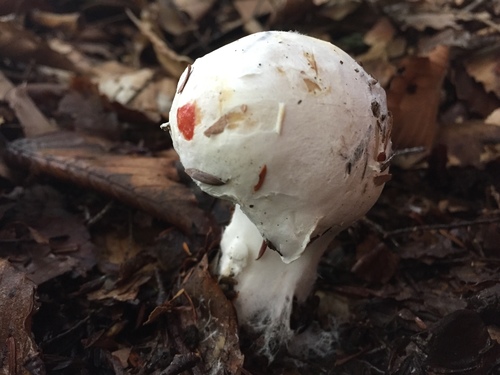
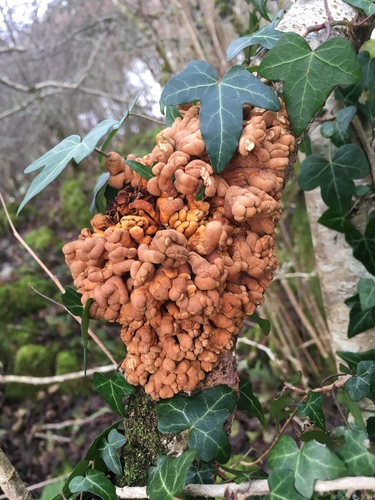
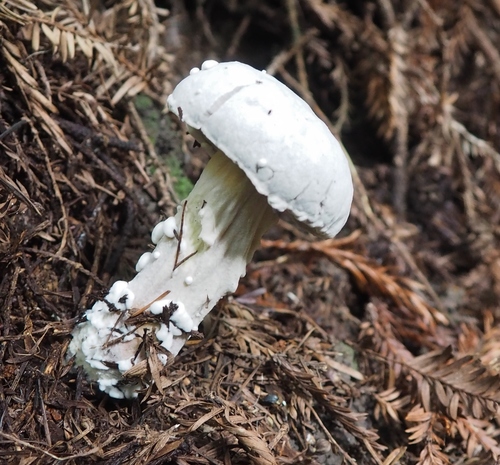
Commonly called the bolete eater, Hypomyces chrysospermus Tul. & C.Tul. infects boletes. Initially, infected mushrooms develop a thin whitish outer layer, which then becomes golden, and finally takes on a reddish-brown pimpled appearance. By the third stage of infection, the bolete's flesh softens and becomes putrid. Infection can affect either single or multiple boletes, and this fungus also attacks species in the genera Paxillus and Rhizopogon. Spores differ in shape, texture, and size across the three growth stages of the fungus. In the asexual white stage, spores are oval, smooth, and measure 10–30 by 5–12 μm. In the asexual yellow stage, spores are round, warty, thick-walled, and 10–25 μm in diameter. In the sexual final stage, spores are spindle-shaped and measure 25–30 by 5–6 μm. Hypomyces chrysospermus occurs in North America and Europe, where it is common. It is also common in southwestern Western Australia, growing in forest and coastal plant communities. Additional records place it in the eastern Chinese provinces of Hebei, Jiangsu, Anhui, and Fujian. This species is not edible and may be poisonous. It is used in traditional Chinese medicine to stop bleeding, most often applied topically to open wounds.