About Hypolimnas misippus Linnaeus, 1764
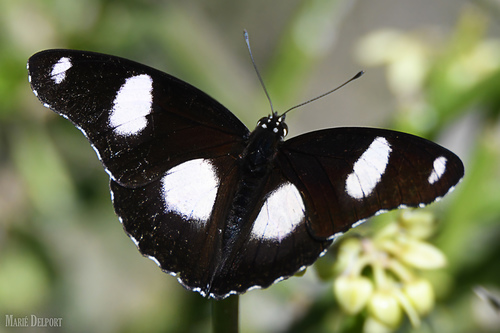
Adults of Hypolimnas misippus are on wing during late summer, between March and April. Their flight activity periods are associated with rainfall patterns, because peak abundances occur shortly after rainfall. They are rarely seen during dry weather. This correlation comes from the growth rates of their food plants and the suitable conditions that support larval growth. This species is found across Africa, Asia, and Australia. In the Americas, it occurs in the West Indies, with stray individuals recorded in Central and North America. It is widely distributed across Indian Ocean islands including the Seychelles, and has been recorded on multiple specific islands: Mahé, Praslin, Aldabra and Cousine. According to de la Chaumette, as noted by Moore, the larva of H. misippus has a cylindrical shape and is predominantly black. It has an even darker black dorsal line running along its back. It is transversely banded with small, pale brown transverse tuberculated spots that contrast against the dark body. The ventral surface is dark olive-brown, while the legs and head are brick-red. The head has two long, thick branched black spines that serve as defensive adaptations. All body segments except the anal segment have a total of ten branched spines that are dirty, transparent white, arranged in longitudinal rows. The anal segment also bears two similar spines. Larvae primarily feed on the leaves of Portulaca oleracea (common purslane, also called little hogweed or pursley), and Asystasia lawiana. The pupa is pendulous, short and thick, with an overall structure that helps it camouflage. It is light brown, and has no metallic spots, which aids its concealment among foliage. It is variegated and streaked with bistre, particularly around the head and tail regions, giving it further environmental adaptations. (de la Chaumette.)