About Hypoedaleus guttatus (Vieillot, 1816)
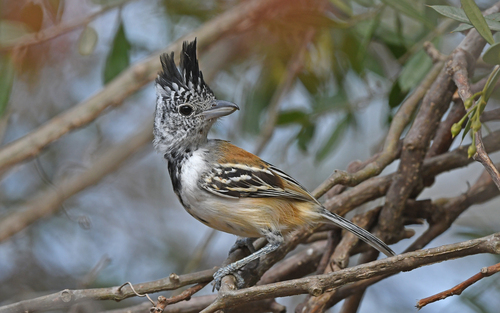
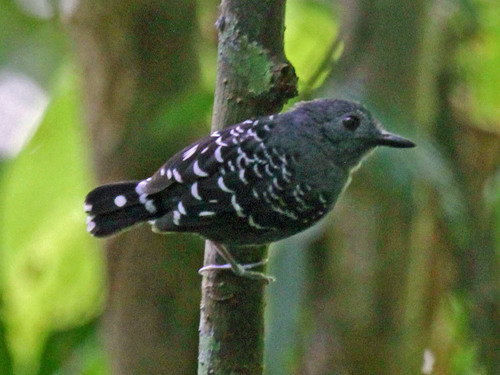
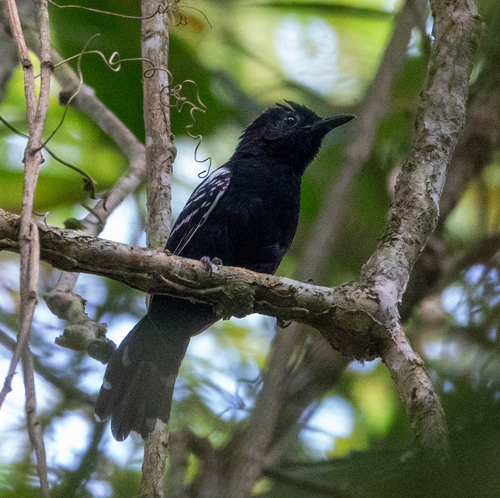
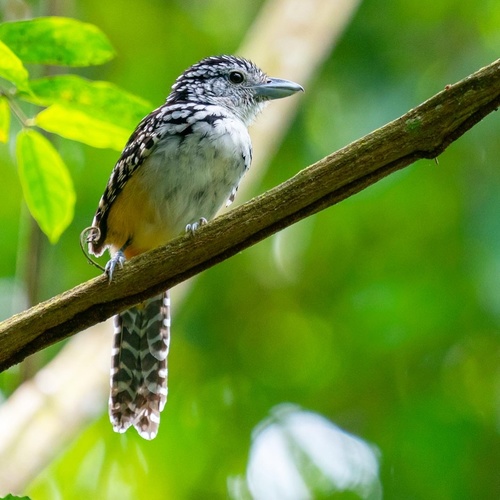
The spot-backed antshrike (Hypoedaleus guttatus) is a large antbird, measuring 20 to 21 cm (7.9 to 8.3 in) in length. This species shows slight sexual dimorphism. Both sexes share a short, heavy gray bill with a hooked tip, a feature similar to the bills of true shrikes. Adult males have black crowns, napes, and upperparts marked with white spots, and a brownish black tail with white barring. Their throats and breasts are white, and their sides are pale gray. In the northern part of the species' range, males' bellies and crissum are nearly white; these areas gradually darken to brownish yellow further south. Adult females have a similar overall pattern to males, but their upperparts have buff spots instead of white, and their underparts have more extensive brownish yellow coloring. The spot-backed antshrike ranges from eastern Alagoas in eastern Brazil south to northern Rio Grande do Sul, extending southwest through eastern Paraguay and into the Misiones Province of northeastern Argentina. It is a species of the Atlantic Forest, where it lives in the subcanopy and canopy of lowland evergreen forest. It almost exclusively occurs in wetter areas with dense vines and other thick vegetation. In terms of elevation, it is found from sea level up to around 900 m (3,000 ft).