About Hypocreopsis lichenoides (Tode) Seaver
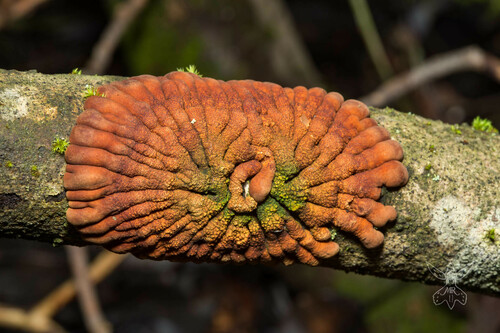
This fungus, Hypocreopsis lichenoides (Tode) Seaver, typically produces single ascocarps, rarely growing in groups. Its ascocarps are leafy, flat, and soft; most reach 3.6 cm wide, though rare individuals can grow up to 11 cm wide, and are 2–4 (rarely up to 5) mm thick. Ascocarps are made up of radially growing or separate perithecial lobes that have finger-like tips along their edges. The surface ranges in color from light brown, through orange-brown and yellow-brown, to ochre, and has a lighter-colored edge. Young fruiting bodies are smooth, sometimes with wrinkling in the center, while mature fruiting bodies have many ostioles.
Microscopically, asci measure (18–) 22–30 × 6–9 μm, are narrowly cylindrical, and contain 8 spores. Ascospores are arranged in a single row inside the ascus, are ellipsoid to short-fusiform, and are 1-septate.
Hypocreopsis lichenoides grows on branches of Salix aurita, Salix cinerea, and has also been recorded growing on Prunus padus, Frangula alnus, Sambucus racemosa, and other species. It is believed to be a parasitic fungus that grows on the fruiting bodies of Hymenochaete tabacina (willow glue). It has been recorded associated with this fungus in Poland, but has also been found growing on decaying wood with unidentifiable pre-existing white rot, which may or may not have been caused by Hymenochaete tabacina.
Hypocreopsis lichenoides is found growing in North America, Europe, Russia, Japan, and Argentina, and is most common in Europe. Recent conservation efforts focused on raising awareness of this fungus (often called willow gloves) in Great Britain have involved carefully translocating specimens from the last remaining Scottish locations to Cumbria. The fungus was previously recorded in Cumbria before it went extinct in England approximately 50 years ago.