About Hypocnemis peruviana Taczanowski, 1884
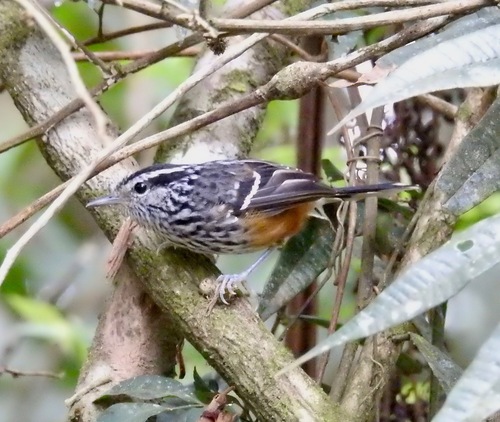
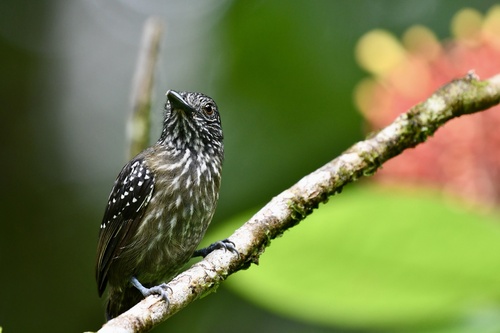
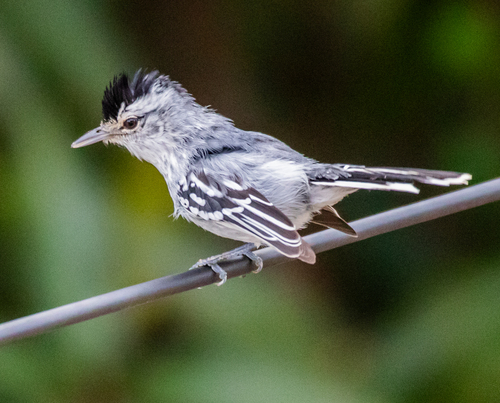
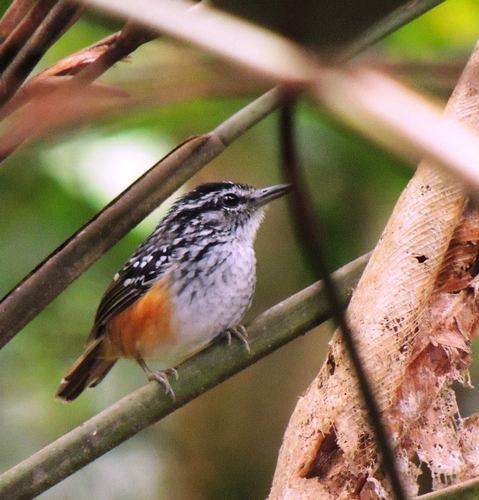
The Peruvian warbling antbird, Hypocnemis peruviana Taczanowski, 1884, is 11 to 12 cm (4.3 to 4.7 in) long. Adult males of the nominate subspecies have a black crown with a white central streak and a white supercilium on an otherwise black and white speckled face. Their upperparts are grayish brown with a white patch between the scapulars and extensive black and white speckling. Their rump is rufous. Their flight feathers are brown with yellowish olive-brown edges, and their wing coverts are black with white tips. Their tail is brown with pale buff tips on the feathers. Their throat and breast are white with many dark spots. Their central belly is whitish, and their flanks and undertail coverts are deep rufous. Females share the same pattern as males but have different colors; their upperparts are heavily marked with dusky and buff. Subspecies H. p. saturata has essentially the same plumage as the nominate subspecies, but is overall somewhat darker.
For distribution and habitat: the nominate subspecies of the Peruvian warbling antbird is found from eastern Peru south of the Amazon into northern Bolivia and southwestern Amazonian Brazil. Subspecies H. p. saturata is found from southern Colombia south through eastern Ecuador into northeastern Peru and east into west-central Amazonian Brazil. In Brazil, the eastern edge of the species' range is the Rio Madeira. In southern Peru, its range overlaps with that of the yellow-breasted warbling antbird (H. subflava). The species primarily inhabits edges and gaps in várzea and igapó evergreen forest, mature secondary forest, and forest along watercourses in more open landscapes. To a lesser extent, it inhabits terra firme forest and somewhat open woodlands.