About Hypochilus thorelli Marx, 1888
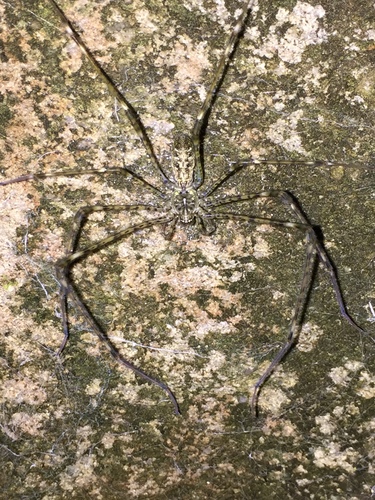
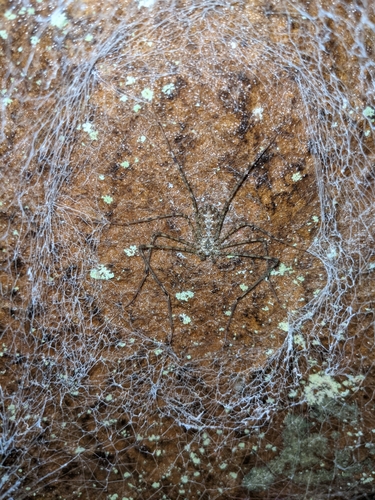
Hypochilus thorelli was first described by Marx in 1888. Females of this species have a cephalothorax around 5.5 mm long and an abdomen (also called opisthosoma) around 9 mm long. Males are smaller: their cephalothorax measures about 4 mm long, and their abdomen measures about 6 mm long. Both sexes have very long legs. A female’s first leg is approximately 63 mm long, while males have longer, thinner legs, with the first leg reaching around 80 mm long. The cephalothorax of both sexes is light yellowish grey, with a darker star-shaped marking on its underside. The upper surface of the abdomen is greyish with irregular black lines and markings, and the underside of the abdomen is whiter. Hypochilus thorelli has eight eyes arranged as two clusters of three, one on each side, plus two additional central eyes. It has both a cribellum and a calamistrum. Like all species in the family Hypochilidae, Hypochilus thorelli has four book lungs. This trait is shared with mesothele and mygalomorph spiders, and differs from the arrangement seen in almost all other araneomorph spiders. The outlines of these book lungs are visible on the underside of the abdomen. Hypochilus thorelli is native to the southern Appalachian Mountains, where it occurs in North Carolina, Tennessee, and extends across state borders into Kentucky, Alabama, Georgia, and South Carolina. Its preferred habitat is described as stream gorges located in humid deciduous forests, at elevations between 600 and 1100 m. High humidity and shade are important requirements for the species, along with suitable overhanging or vertical surfaces that it uses for building webs.