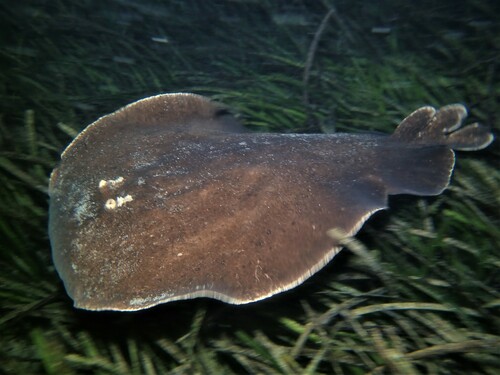
About Hypnos monopterygius (Shaw, 1795)
The coffin ray, Hypnos monopterygius, is easily distinguished from all other rays by its unusual pear-like body shape. Its body is flabby, and two large, kidney-shaped electric organs are visible on both sides of the head. Its pectoral fins form a greatly enlarged disc that is about as wide as it is long, thick at the center and thin at the margins. The leading margin of the disc is straight to gently concave. This ray has very small eyes that can be elevated on short stalks. Close behind the eyes are slightly larger spiracles, which some individuals have rimmed with small papillae. Nostrils sit just ahead of the mouth, connected to it by a pair of broad grooves; a short curtain of skin between the nostrils overlaps the mouth. The spacious mouth forms a very long, wide arch, and its slender jaws can be dramatically distended, though they are not particularly protrusible. Adult coffin rays have over 60 rows of small, three-cusped teeth in each jaw. Five pairs of small gill slits are located beneath the disc. The relatively large pelvic fins merge with the front of the pectoral fin disc to form a roughly circular secondary disc. Two rounded lobe-shaped dorsal fins sit very close to the caudal fin, which is similar in size with a nearly symmetrical, rounded edge. The tail is extremely short, so the caudal fin barely extends past the pelvic fin disc. The skin has no dermal denticles, and may be creased in some areas. Dorsal coloration ranges from dark brown to reddish brown, grayish, pinkish, or yellowish; it may be plain or sparsely marked with irregular darker and lighter patches. The underside is pale, as are the spiracle papillae. This species reaches a maximum recorded length of 70 cm (28 in), and may possibly grow to 92 cm (36 in), though most individuals are only around 40 cm (16 in) long. The coffin ray has a wide but disjunct distribution in tropical and warm-temperate waters around Australia. The western section of its range runs from Gulf St Vincent in South Australia to Broome in Western Australia, while the eastern section extends from Eden in New South Wales to Heron Island in Queensland. It is not found in waters off Victoria or Tasmania. This common bottom-dwelling species is typically found close to shore at depths no greater than 80 m (260 ft), though it has been recorded as deep as 240 m (790 ft). In 1910, the trawler Endeavour caught multiple coffin rays at depths between 47 and 120 fathoms (86–219 metres). It prefers habitats with sandy or muddy bottoms, including beaches, estuaries, and bays, and can also be found over seagrass, as well as on and around rocky and coral reefs. The coffin ray is a slow, weak swimmer that moves in a jerky, fluttery motion. It is nocturnal, and spends most of the day buried in sediment with only its spiracles exposed. When disturbed, it has been observed doing a possible defensive behavior: it erupts from the seabed and swims in a loop with its mouth open. It sometimes becomes stranded on shore when the tide recedes, but can survive out of water for hours. Like other electric rays, the coffin ray’s electric organs are derived from muscle tissue, and are made up of many vertical columns; each column is formed from a stack of jelly-filled "electric plates" that acts essentially as a battery. It can generate up to 200 volts of electricity, and can deliver 50 shocks over a ten-minute period, with each subsequent shock growing weaker. The coffin ray uses electricity both to subdue prey and deter predators. Its diet consists mostly of bottom-dwelling bony fishes, but also includes cephalopods, and occasionally crustaceans and polychaete worms. Penguins and rats have also been found in the stomachs of this species. The coffin ray ambushes prey from the seabed, swallows prey whole head-first, then re-buries itself. It often takes prey that is extremely large relative to its own size: one observed 60 cm (24 in) long individual had swallowed a 70 cm (28 in) long flathead (Platycephalus sp.), and the prey’s tail was still sticking out of its mouth. Dead specimens have been found that apparently choked to death while trying to swallow overly large prey. The coffin ray is aplacental viviparous: developing embryos are first nourished by yolk, and later receive additional nourishment from histotroph, or "uterine milk", secreted by the mother. Females give birth to litters of 4–8 pups in summer; newborns measure approximately 8–11 cm (3.1–4.3 in) long. Both males and females reach sexual maturity when they are around 40–48 cm (16–19 in) long. This species is parasitized by the tapeworms Acanthobothrium angelae and Lacistorhynchus dollfusi, and the nematode Echinocephalus overstreeti. It is preyed on by tiger sharks; one large tiger shark caught at Port Stephens in the early 20th century had more than thirty coffin rays in its stomach.

