About Hypnale hypnale (Merrem, 1820)
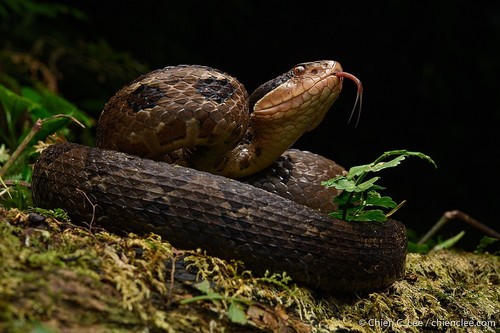
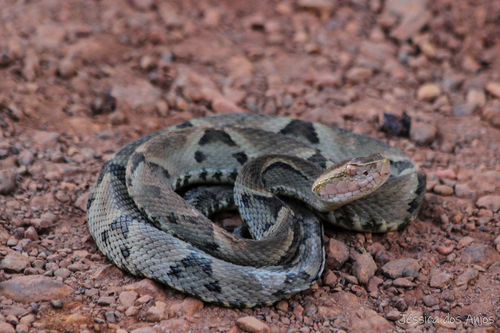
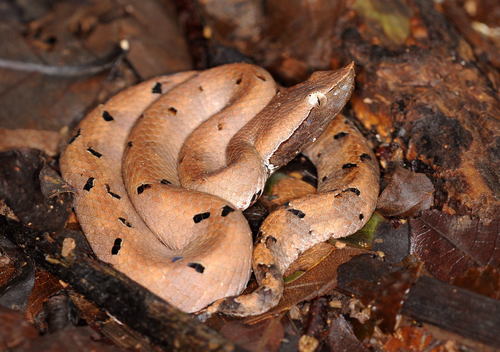
This species is known scientifically as Hypnale hypnale (Merrem, 1820). Adult individuals reach an average total length (including the tail) of 30 to 45 cm, or 12 to 18 inches. The Armed Forces Pest Management Board gives a different total length range of 0.4 to 0.6 m, which equals 1 foot 4 inches to 2 feet 0 inches. It has the characteristic build of a viperid, with a stout body and a wide head. Its snout is pointed, turned upwards, and ends in a distinct hump. The large scales covering the top of its head (frontal, supraoculars, and parietal shields) are large, while the scales on its snout are small and irregular. Its coloration is grayish with heavy brown mottling, marked with a double row of large dark spots. Its belly is brownish or yellowish with dark mottling, and the tip of its tail is yellow or reddish. According to M.A. Smith’s 1943 publication, Hypnale hypnale occurs from peninsular India, ranging north along the Western Ghats to 16° N, and also occurs across Sri Lanka. Its documented type locality is Castle Rock, Karnataka, India. It inhabits dense jungle and coffee plantations located in hilly areas. Reproductively, adult females are viviparous, giving birth to live young between March and July. Brood size ranges from 4 to 17 offspring, and newborns measure 13 to 14.5 cm, or 5.1 to 5.7 inches, in total length.