About Hyphaene petersiana Klotzsch ex Mart.
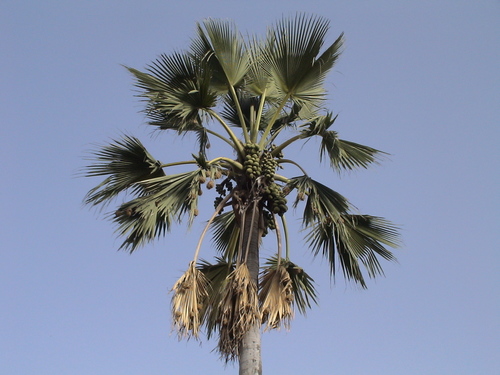
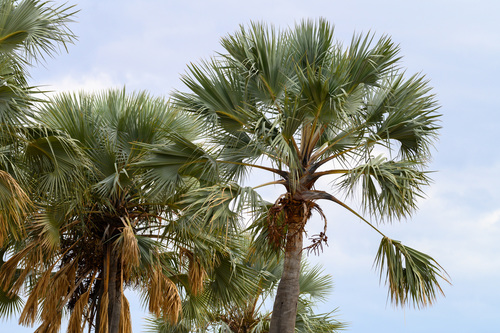
Hyphaene petersiana, commonly known as the real fan palm or makalani palm, is a species of palm tree native to subtropical low-lying regions of south central Africa. It occurs in Burundi, Rwanda, the Democratic Republic of the Congo, Tanzania, Angola, Mozambique, Malawi, Zambia, Zimbabwe, Botswana, Namibia, and the northern and north-eastern part of Limpopo. This palm grows in open woodland, flood plains, river banks, and on the fringes of pans and swamps. Like other species in the Hyphaene genus, H. petersiana is dioicous. Female plants produce large amounts of fruit that is around 60 millimeters in diameter. A single tree can hold up to 2,000 fruits, which is the combined yield from approximately four growing seasons. The seeds of this palm are difficult to germinate, but saline growing conditions improve germination. Seedlings develop large tap-roots that pull saline water from deep underground. H. petersiana is a slow-growing species. It can reach a maximum height of 18 meters, though typical adult plants stand between 5 and 7 meters tall. Both humans and animals use this plant. Repeatedly cutting the growing point to collect sap for palm wine production can eventually kill the trees. The pith of the stem is edible. Under the outer fibrous husk of the fruit is a core of white endosperm called vegetable ivory. This endosperm is initially soft and edible, and contains a liquid similar to coconut milk. The Ovambo people call the fruit of the makalani palm eendunga, and use it to distill ombike, their traditional liquor. Regionally, African palm swifts and rufous-tailed palm-thrushes depend on H. petersiana for breeding.