About Hyphaene coriacea Gaertn.
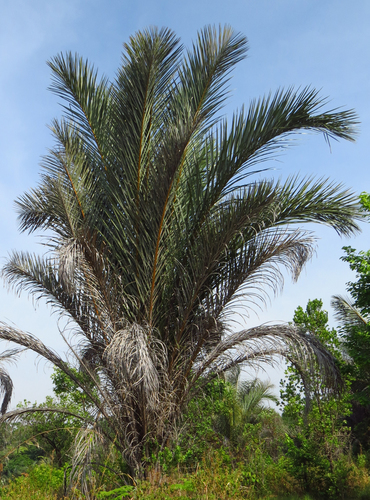
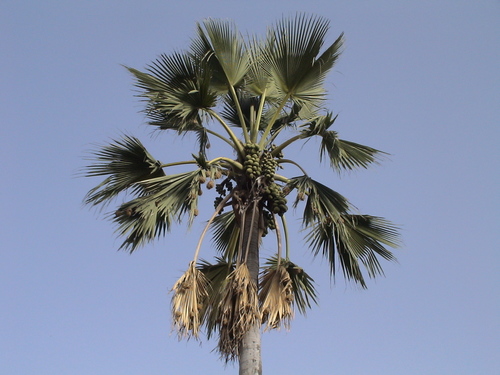
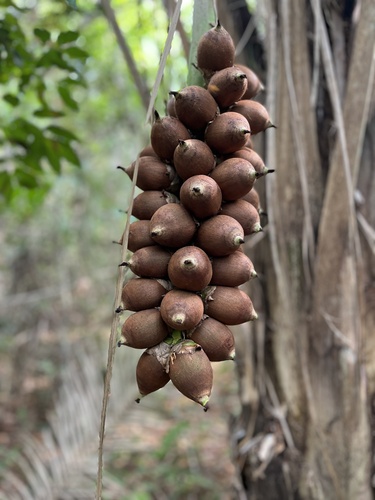
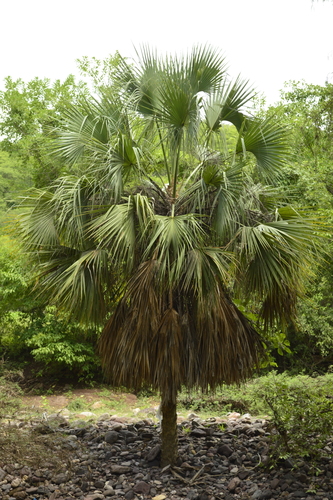
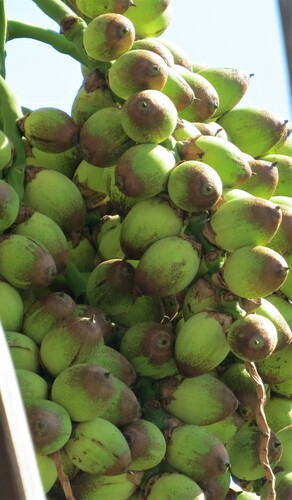
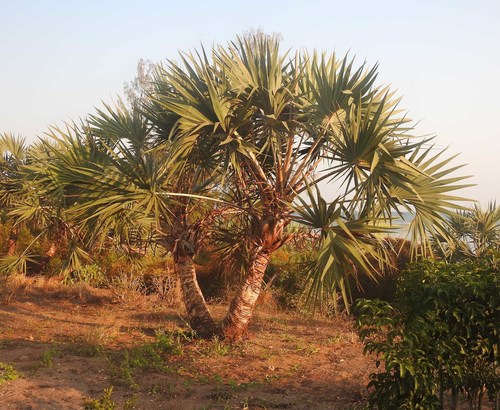
Hyphaene coriacea Gaertn. is a clustering palm species that most often grows in groups of 2 to 6 individual plants, though it may occasionally appear as a solitary specimen. Its trunk reaches 1 to 6 meters in height and 10 to 20 centimeters in diameter. Trunks are typically unbranched, but occasional branching does occur, and they are covered in old leaf bases that form a criss-cross pattern. The crown holds 9 to 20 spreading leaves with recurved rachis, and the entire leaf can grow up to 1.8 meters long. The open leaf sheath reaches up to 40 centimeters in length, is waxy brown in color, and has fibrous margins. The petiole measures between 60 and 97 centimeters long; it widens at its base and narrows toward its distal end, and bears black triangular spines up to 1 centimeter long. The leaf blade is approximately 70 centimeters long and 112 centimeters wide, divided into 39 to 55 segments, with filaments present at the sinuses between segments. Outer leaf segments are 31 to 48 centimeters long, while central segments measure 40 to 58 centimeters long. Faint minor veins on the leaves are covered in scattered reddish scales. Male inflorescences emerge between leaves, are branched to two orders, and bear rachillae 9 to 36 centimeters long that grow either solitary or in groups. Male flowers have greenish corolla lobes, yellow anthers, and a small pistillode. Female inflorescences also emerge between leaves, measure 60 to 120 centimeters long, and are branched to one order, holding 2 to 5 pendulous rachillae. Female flowers have slightly obovate petals, thin staminodes, and a globose ovary. The fruit is irregularly top-shaped, 5 to 6 centimeters high, 4 to 6 centimeters in diameter, and grows on a hairy pedicel up to 12 millimeters long. The fruit's mesocarp is fibrous, and its endocarp is hard and woody. Seeds are approximately 2.7 centimeters wide, with a homogeneous endosperm and a central hollow. The spongy pulp of the hard brown fruit of this palm is edible. The fruit is eaten and sold commercially in Madagascar and eastern Africa, where it is known by the Swahili name Mkoma. Its flavor has been compared to raisins and raisin bran.