About Hyperprosopon argenteum Gibbons, 1854
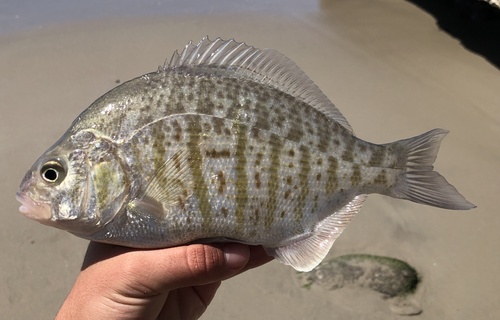
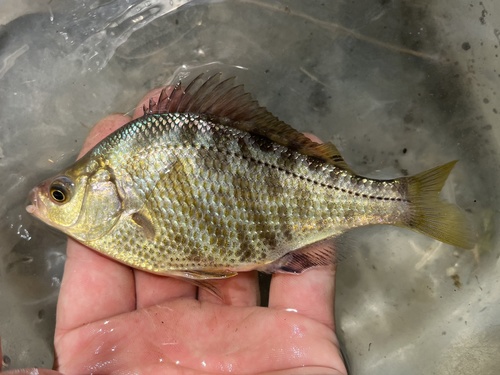
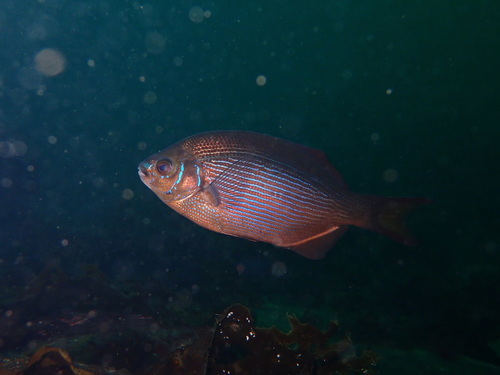
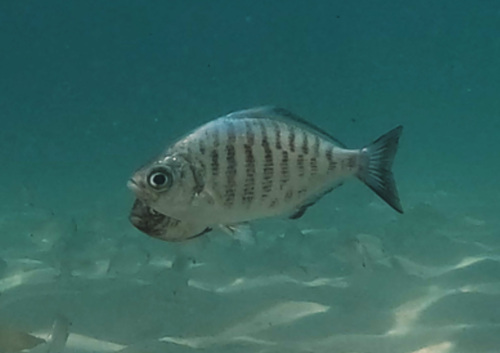
Hyperprosopon argenteum, commonly known as the Walleye surfperch, has an oval, strongly compressed body, a small head, large eyes, and a small mouth that slants upwards. Its typical coloration is silver with faint dusky shading on the back, and it may have broken vertical bars along its sides. This species can be distinguished from other surfperch, particularly the closely related similar silver surfperch (Hyperprosopon ellipticum), by the unique black tips on its pelvic fins, plus black borders along its tail and anal fins. The maximum recorded total length for this species is 30.5 cm (12.0 in), though most individuals grow to under 26 cm (10 in).
Walleye surfperch are native to the Eastern Pacific Ocean, with a range extending from Vancouver Island, British Columbia, Canada down to Central Baja California, Mexico. This range includes Guadalupe Island, located off northern-central Baja California. They inhabit the surf zone along sandy beaches, near rocky outcrops, and around piers and other artificial aquatic structures.
Mating for Walleye surfperch occurs between October and December. During this period, their normally dense schools disperse, and males and females pair off to mate. If another male approaches a paired couple, the courting male will immediately charge quickly toward the intruding male. This species is viviparous, meaning females give birth to live young. Litter size ranges from 1 to 19 young, and depends on the size of the mother. The young are born the following spring, and average just over 3.8 cm (1.5 in) long at birth. They reach sexual maturity the following fall and winter; most of the breeding population is made up of young of the year. Like most other surfperch species, Walleye surfperch are likely short-lived. One recorded 27 cm (10.5 in) individual was only 6 years old.
Walleye surfperch typically form dense schools, sometimes mixing with other surfperch species. Their large eyes make them primarily nocturnal feeders, though they can also be caught during daytime. Their diet consists of small crustaceans and zooplankton.