About Hyperoodon ampullatus (Forster, 1770)
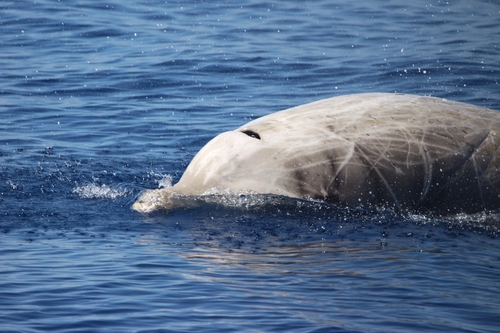
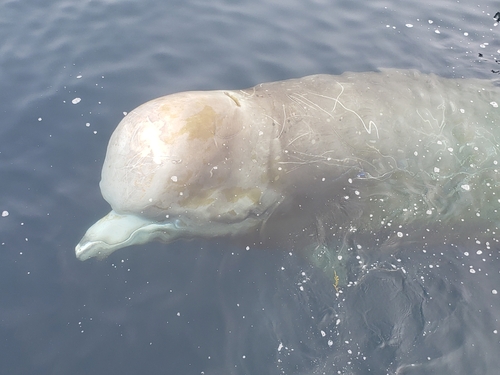
Physically mature northern bottlenose whales (Hyperoodon ampullatus) reach up to 9.8 metres (32 ft) in length, making them smaller than giant beaked whales and larger than recorded southern bottlenose whales. Their foreheads (called melons) are sexually dimorphic: mature males have larger, flattened or square-shaped melons, while mature females and juveniles have rounder melons. Melon coloration varies, but most males' heads become more white or buff as they age. Their beak is shorter than that of other beaked whale species. Only mature males have two small teeth that erupt at the front of the lower jaw, and these teeth are not easily seen; females also have teeth, but they remain buried in the jaw and never erupt. The dorsal fin is relatively small, measuring 30–38 centimetres (12–15 in), and is positioned around two-thirds of the way back along the body. It is falcate (sickle-shaped) and usually pointed. The back is mid-to-dark grey, with a lighter underside. Adult northern bottlenose whales weigh approximately 5,800–7,500 kilograms (12,790–16,530 lb). The oldest recorded age, counted from annual growth layers in a tooth of a whaled specimen, was 37 years. Calves have prolonged weaning, with nursing continuing until juveniles are 3–4 years old. Males reach sexual maturity between 7 and 11 years old, while females reach sexual maturity between 8 and 12 years old. This species inhabits ocean areas deeper than 6,500 feet. The northern bottlenose whale is endemic to the North Atlantic Ocean, and populations live in deep (over 500 m) cold subarctic waters of the Davis Strait, Labrador Sea, Greenland Sea, and Barents Sea, but can range as far south as Newfoundland and Nova Scotia. As of 2017, the North East Atlantic population is estimated to number between 10,000 and 45,000, though overall population numbers remain very poorly understood. "The Gully", a large submarine canyon east of Nova Scotia, hosts the "Scotian Shelf" population of 164 whales, which is currently listed as endangered under Canada's Species at Risk Act. This population has been the focus of a long-term research project run by the Whitehead Lab at Dalhousie University since 1988. In 1976, the Scientific Committee of the International Whaling Commission recognized a single northern bottlenose whale population across the North Atlantic. In 2011, COSEWIC determined there are two populations off eastern Canada (the Scotian Shelf and Labrador-Davis Strait Designated Units), and recent studies have confirmed these two populations are genetically distinct from one another. Individual northern bottlenose whales have also been sighted off the Azores and Canary Islands.