About Hypericum scouleri Hook.
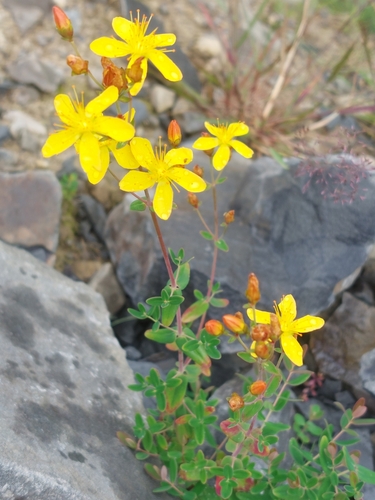
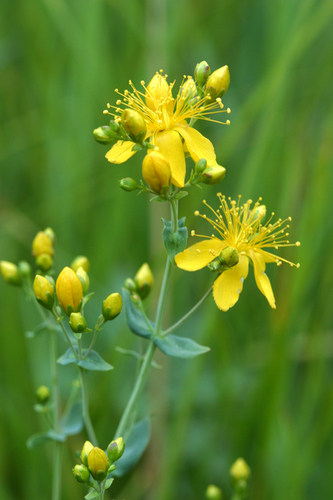
Hypericum scouleri Hook. is a herbaceous plant. Its stems are either vertical, or grow outward a short distance before curving upward. Mature stems typically reach 5 to 66 centimeters in height, and may occasionally grow as tall as 80 centimeters. Stems sprout from a creeping rootstock, and are only branched infrequently. Between nodes, stems usually have two faint lines, but may also lack these lines entirely. Stems do not have black glands, though they may occasionally have reddish glands.
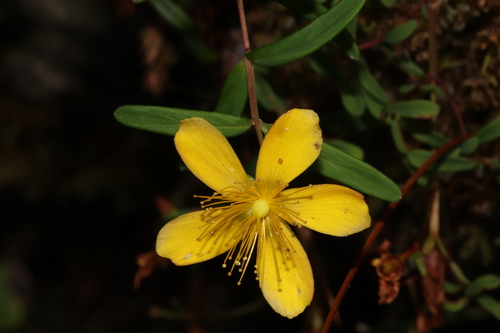
Leaves are attached opposite one another on stems at the nodes. They usually spread outward, but may occasionally point upward instead. Leaf shape varies: it may be ovate (egg-shaped, with the widest part toward the base), elliptic (with curved sides and the widest portion in the middle), or oblong (a rectangular shape with rounded corners). Leaves measure 12 to 32 millimeters in length (most often shorter than 28 millimeters) and 6 to 18 millimeters in width. Leaves are covered in black oil glands that appear translucent when held up to light.
This species grows in western North America, ranging from southern Canada to central Mexico. In Canada, it occurs in the provinces of British Columbia and Alberta; within British Columbia, it is found in southern Vancouver Island and the province's southern interior mountains. In the United States, it grows from the Pacific coast to the Rocky Mountain States, and is restricted to mountainous areas of Montana, Wyoming, Colorado, and New Mexico. In Mexico, it occurs in four states: Chihuahua, Zacatecas, Michoacán, and Hidalgo.
Hypericum scouleri prefers moist locations, including streambanks and open areas in well-watered quaking aspen groves. In the Rocky Mountains, it grows at elevations matching where ponderosa pines grow, or in montane spruce-fir forests. In the Great Basin, it grows in riparian areas of the sagebrush steppe and extends into more mountainous areas. It often forms fairly large colonies.
The klamathweed beetle (Chrysolina quadrigemina) was introduced to North America as a biological pest control agent for Common St. John's wort. While laboratory tests confirm beetles can successfully complete their lifecycle on Hypericum scouleri and related native species, the beetle has not been observed feeding on H. scouleri in natural conditions. Scientists hypothesize this difference is caused by the differing habitat requirements of the two plant species.
In 2019, NatureServe evaluated Hypericum scouleri as globally secure (G5), meaning the species faces no significant threats and has no known population declines. At the local level, NatureServe assessed it as secure (S5) in British Columbia, and critically imperiled (S1) in neighboring Alberta. In the United States, it is assessed as apparently secure (S4) in Wyoming and vulnerable (S3) in Nevada; the rest of the species' range has not been evaluated.