About Hypericum orientale L.
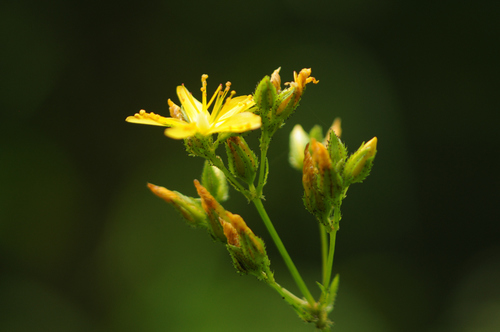
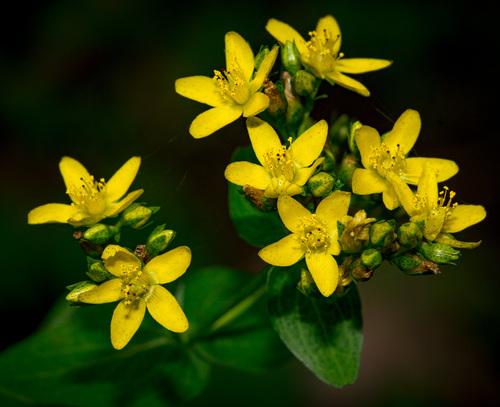
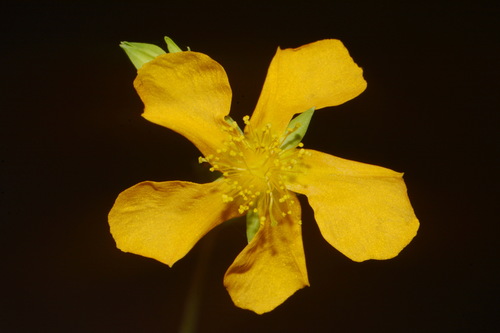
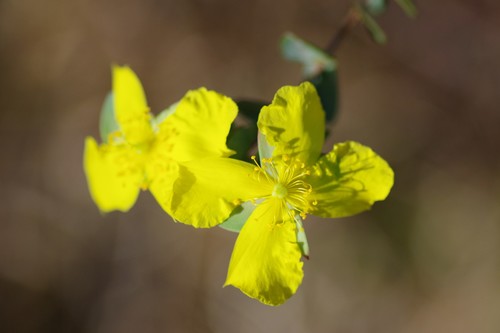
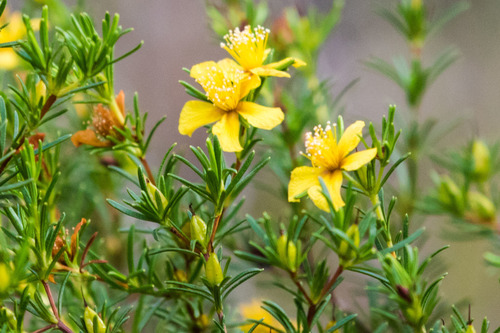
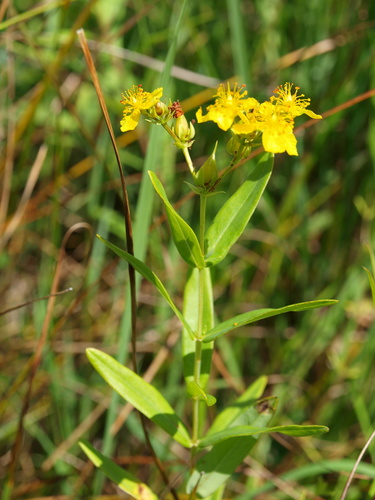
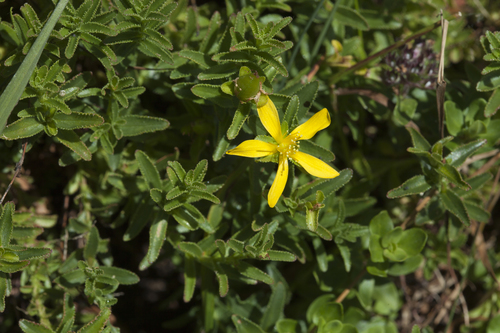
Hypericum orientale L. is a small perennial herb, growing 7 to 45 cm (2.8 inches to 1 foot 5.7 inches) tall. Its growth habit is both prostrate along the ground and upright, and it sometimes roots at its base. Many spreading, branching stems grow from a single taproot, and these stems do not branch further near the inflorescence. Stems are two-lined, and either lack glands entirely or bear a small number of scattered or linearly arranged reddish glands. Leaves attach directly to the stem and angle slightly upward. Leaf blades measure 1–4 cm (0.39–1.57 in) long by 0.2–1 cm (0.079–0.39 in) wide, and range in shape from narrow oval to oval lanceolate. Leaves are the same color as the rest of the plant, have a papery texture, and end in a rounded point. Leaf blade edges have shallow glands and a finely toothed (denticulate) texture, while the leaf base is wedge-shaped and bears paired auricles. Glands on the leaf blade are pale and point-shaped, and glands along the edge sit on the fine teeth. Each inflorescence holds roughly three flowers across 1 to 3 nodes, and additional flowering branches often grow from 1 to 3 more nodes below the main inflorescence. The entire inflorescence structure ranges in shape from an inverted pyramid to a cylinder. Bracts are similar in shape to vegetative leaves, but are fringed with glands. Each flower is roughly 4 cm (1.6 in) in diameter, with elliptical buds that have rounded ends. Sepals vary in length and barely overlap, measuring 0.4–0.7 cm (0.16–0.28 in) long by 0.2–0.5 cm (0.079–0.20 in) wide. Petals are bright yellow with no red tinge, and measure 1–1.8 cm (0.39–0.71 in) long by 0.2–0.4 cm (0.079–0.16 in) wide; the total number of petals is approximately 2.5 times the number of sepals. There are between 30 and 45 stamens; the longest stamens measure 0.7–1.3 cm (0.28–0.51 in) long, and have an amber-colored anther gland at the tip. Ovaries are narrowly oval, and the number of styles is roughly twice the number of ovaries. The seed capsule measures 0.8–1.1 cm (0.31–0.43 in) long by 0.3–0.5 cm (0.12–0.20 in) wide, and has many grooves. Seeds are medium brown, and measure 0.1–0.15 cm (0.039–0.059 in) long. Parts of Hypericum orientale are edible, and the species has documented uses in folk medicine. In Turkey, a decoction of the plant has been used to treat hemorrhoids, and it has also been used as a sedative.