About Hypericum majus (A.Gray) Britton
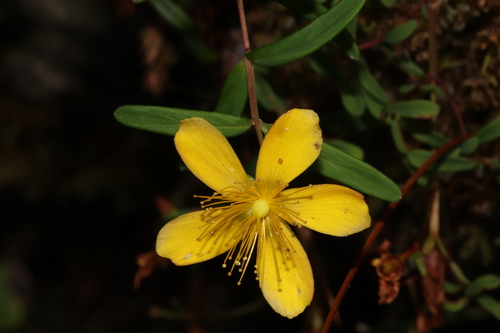
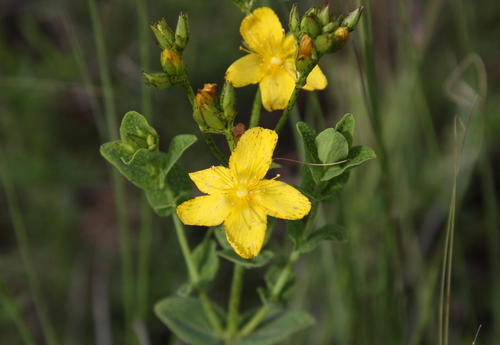
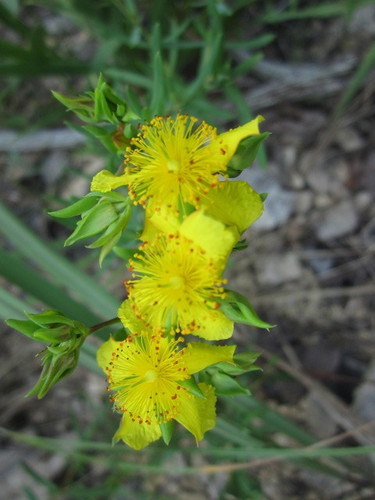
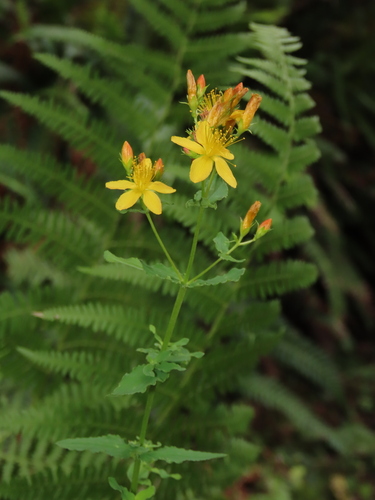
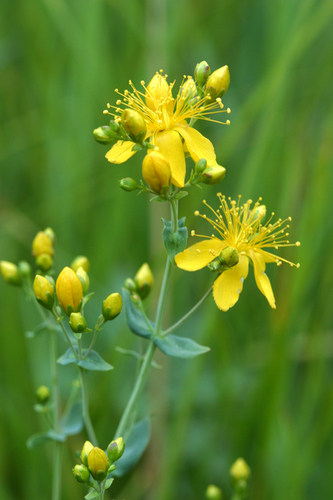
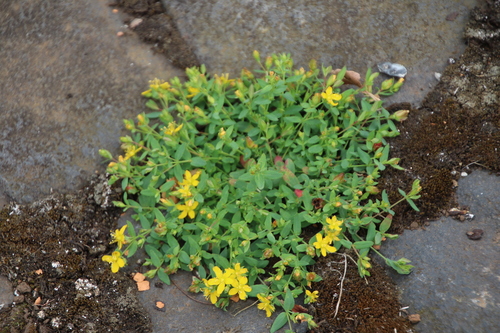
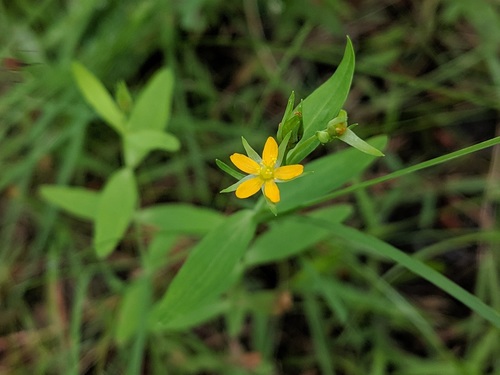
Hypericum majus (A.Gray) Britton is a perennial herb with a taproot. It produces short leafy shoots, with stems that grow either solitary or in tufts; the stems are erect and stout, reaching 10–70 cm (3.9–27.6 in) in height. The root system is fibrous, lacking rhizomes or runners, but the plant can grow short offshoots in autumn. Stems are four-angled, squarish, green, and may become ancipitous; they typically branch more heavily in the upper half of the plant, though branches may also grow from the lower half if the terminal meristem is damaged. Internodes measure 1–4 cm (0.39–1.57 in), and upper internodes often grow longer than the plant’s leaves. Leaves are arranged oppositely, are simple in structure, and lanceolate in shape; they measure 1.5–4.5 cm (0.59–1.77 in) long and 5–15 mm (0.20–0.59 in) wide. Leaves are either erect or spreading, are planar and chartaceous, with apices ranging from acute to rounded, cuneate bases, and entire margins. Upper leaves have five to seven veins that arise from their rounded, sessile or clasping bases. Basal leaves are more purplish in color, are crowded, and measure 4–5 mm (0.16–0.20 in) long and 2–3 mm (0.079–0.118 in) wide. Dense tertiary reticulation is present, along with dense laminar glands that form a punctiform pattern. The plant’s terminal inflorescence holds three to thirty flowers. Inflorescence branching is mostly dichasial, with ascending pairs of flowering branches growing from up to five nodes below the top of the stem. The full inflorescence is corymbiform to cylindric, though smaller plants produce a simple, nearly naked cyme. Cymes are subtended by slender bracts that measure 3–4 mm (0.12–0.16 in) long. Pedicels are 3–5 mm (0.12–0.20 in) long, and the star-shaped flowers are 6–7 mm (0.24–0.28 in) wide, with the central flower being the largest. Sepals are lance-attenuate, measuring 4–7 mm (0.16–0.28 in) long and 0.8–1.5 mm (0.031–0.059 in) wide; two sepals are typically longer and wider than the other three. Sepals have three to five veins, with a visible midvein, and do not have punctiform glands. Petals are golden yellow, occasionally tinged pink, and measure 3.5–6 mm (0.14–0.24 in) long and 1.25–1.75 mm (0.049–0.069 in) wide; they are equal in length to or shorter than the sepals. The twelve to twenty-one stamens are weakly grouped into five fascicles, with the longest stamen measuring 2.5–3.5 mm (0.098–0.138 in). The sessile pistil is roughly 3 mm (0.12 in) long and ovoid in shape. The ovoid to ellipsoid ovary measures 1.5–2 mm (0.059–0.079 in) long and 0.8–1 mm (0.031–0.039 in) wide. The three carpels are distinct when young and become indistinct as they mature. The three styles measure 0.6–1 mm (0.024–0.039 in) long. The fruit is a conic-ellipsoid capsule that measures 4–8 mm (0.16–0.31 in) long and 2.5–3.5 mm (0.098–0.138 in) wide. Seeds measure 0.5–0.7 mm (0.020–0.028 in) long. H. majus can be told apart from other small-flowered Hypericum species by its leaves that have five to seven veins. This herb flowers from June to September. Hypericum majus grows in wet or dry open soil in bogs, marshes, ditches, meadows, woodlands, and other damp habitats. It prefers elevations between 0–1,200 m (0–3,937 ft). It occurs naturally from New Brunswick and Quebec to southern British Columbia in Canada; to the south, its natural range extends from Maine to Washington, and as far south as Colorado, Kansas, and Ohio in the United States. It was introduced to France by 1955, to Germany by 1948, and to Japan by 1974; the method of its introduction to these regions is unknown.