About Hypericum denticulatum Walter
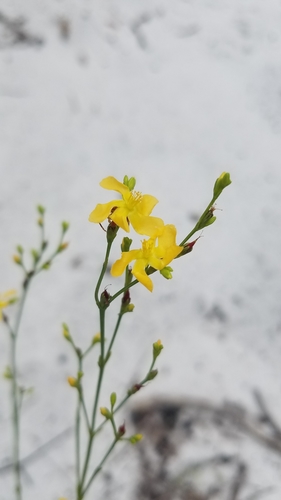
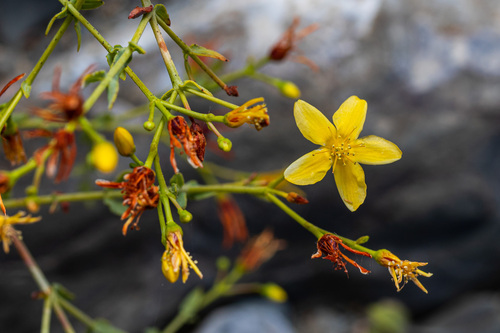
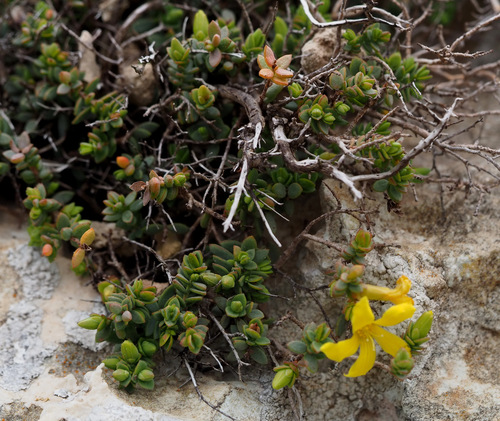
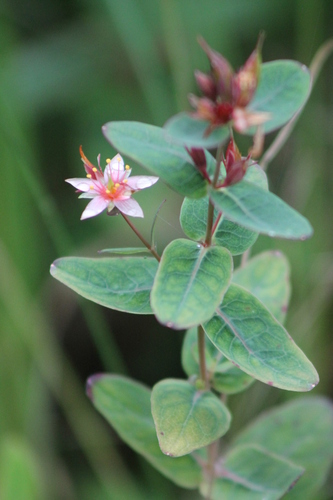
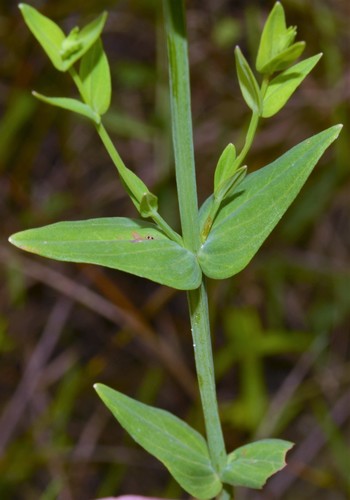
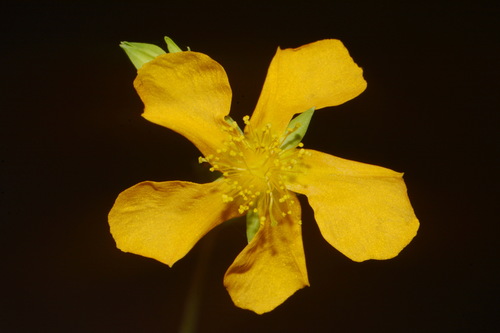
Hypericum denticulatum Walter is an erect perennial plant that is usually entirely glabrous. It has slender, herbaceous stems that are either straight or ascending, typically growing in clumps from surculose bases. The four-angled stems are densely dotted, reach 25–65 cm (9.8–25.6 in) in height, and have four-lined internodes that measure 8–47 mm (0.31–1.85 in). Stems only branch at their typically aerenchymatous base and within the inflorescences. Its nearly erect leaves are ovate, oval, or oboval, with acute tips and rounded sessile bases. The leaves are thick, leathery, and firm; the longest leaves measure 0.8–2.5 cm (0.31–0.98 in) in length, and most measure 0.6–1.7 cm (0.24–0.67 in) wide, with most leaves being shorter than the internodes. Leaves are typically flat, but may recurve when dried. They have one to five basal veins and are densely dotted. Terminal inflorescences range from pyramidal to corymbiform, and hold up to 25 scattered racemose flowers on their ascending branches. The inflorescence becomes monochasial after the fourth grade, with lateral dichasial or monochasial branches six nodes below that hold up to fifteen flowers each. Pedicels are 2–4 mm (0.079–0.157 in) long, and bracts are 3–6 mm (0.12–0.24 in) long. The star-shaped flowers are 5–13 mm (0.20–0.51 in) wide. Its herbaceous sepals are oblong to narrowly ovate with acute apices, measuring 3–8 mm (0.12–0.31 in) long and 1.5–4 mm (0.059–0.157 in) wide, with three to five veins per sepal. Petals are coppery yellow, and measure 5–10 mm (0.20–0.39 in) long and 4–6 mm (0.16–0.24 in) wide. There are 50 to 80 irregularly spaced stamens, the longest of which measure 3–5 mm (0.12–0.20 in). The ovoid ovary is 1.5–2 mm (0.059–0.079 in) long and 1–1.5 mm (0.039–0.059 in) wide. The single-locular capsule is ovoid and retained by the sepals. The three distinct, short styles are 2–4 mm (0.079–0.157 in) long and bear capitate stigmas. Ovoid capsules measure 3–5 mm (0.12–0.20 in) long and 2–3 mm (0.079–0.118 in) wide, and seeds are 0.4–0.7 mm (0.016–0.028 in) long. H. denticulatum closely resembles Hypericum erythreae, but can be told apart by its shorter stems and denser foliage. Two subspecies are recognized. H. denticulatum subsp. denticulatum is distinguished by its shorter stature, growing 0.2–0.7 m (7.9 in – 2 ft 3.6 in) tall, and its shorter lower internodes. Its appressed leaves are 2–20 mm (0.079–0.787 in) long and 5–15 mm (0.20–0.59 in) wide. Its sepals are 4–8 mm (0.16–0.31 in) long and 2–4 mm (0.079–0.157 in) wide. It has a diploid chromosome number of 24 or 48, and grows in moist ditches, pine barrens, and prairies at elevations between 0–400 m (0–1,312 ft). H. denticulatum subsp. acutifolium is taller than subsp. denticulatum, reaching 0.4–0.75 m (1 ft 4 in – 2 ft 6 in) in height. Its leaves are 10–35 mm (0.39–1.38 in) long and 3–8 mm (0.12–0.31 in) wide. Its sepals are 3–3.5 mm (0.12–0.14 in) long and 1.5–2.5 mm (0.059–0.098 in) wide. Its petals tend to be more yellow and less orange than the nominate subspecies. It has a diploid chromosome number of 24. This subspecies grows on dry roadsides, in fields, and in woodlands at elevations up to 700 m (2,300 ft) or possibly higher, and has a less coastal distribution than the other subspecies. Overall, Hypericum denticulatum grows on sandy or clay shores, in swamps, ditches, on gravelly hills, and in pine barrens at altitudes between 0–700 m (0–2,297 ft). The species occurs in Alabama, Delaware, Georgia, New Jersey, New York, North Carolina, South Carolina, Pennsylvania, Tennessee, and Virginia, and is rare in Illinois where it occurs as H. denticulatum var. recognitum.