About Hyparrhenia rufa (Nees) Stapf
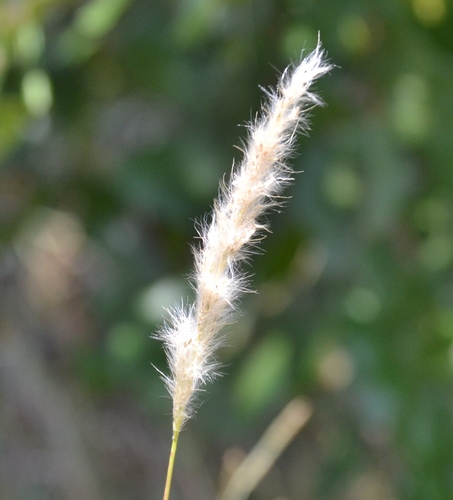
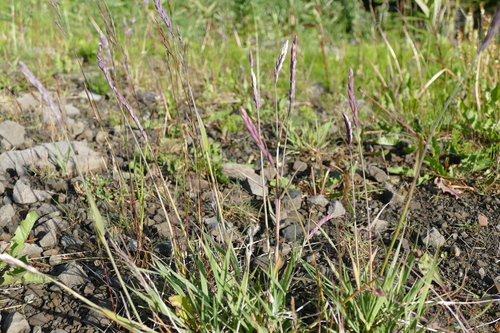
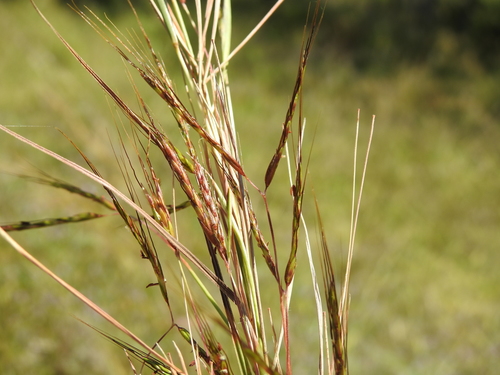
Hyparrhenia rufa (Nees) Stapf is most often a perennial grass, but it may occasionally grow as an annual, and it has variable form. It typically forms dense tufts of stems from a short rhizome. Stems range from 30 centimeters to 3.5 meters in height. Leaf sheaths wrap around the stem at intervals, creating a banded appearance. Flowering stems have only a small number of leaves, but grazing increases the plant’s leaf production. Leaf blades measure 30 to 60 centimeters long. The panicle can reach up to 80 centimeters in length, and is composed of many short, yellowish or red-tinged racemes. Each raceme is subtended by a narrow, reddish spathe a few centimeters long. Racemes are lined with paired spikelets: unstalked fertile spikelets covered in red hairs, and smaller stalked sterile spikelets. Its rough-haired seeds are dispersed via animal fur, wind, and vehicles or machinery such as graders. In its native range, this grass grows in woodlands and seasonally flooded grasslands. It is drought tolerant, and easily naturalizes in disturbed habitats. Multiple leafcutter ant species have been observed foraging on Hyparrhenia rufa, including Atta capiguara and A. laevigata. The grass is susceptible to three species of plant pathogenic nematodes: Helicotylenchus pseudopaxilli, Pratylenchus brachyurus, and Longidorus laevicapitatus. It can also act as a host for the phytoplasma bacterium that causes stunting in Napier grass (Pennisetum purpureum); infection in Hyparrhenia rufa is called Hyparrhenia grass white leaf disease. This tall grass can be used for thatching, as straw, and as pulp for paper production. In East Africa, it is planted as a border grass to prevent erosion.