About Hypanus sabinus (Lesueur, 1824)
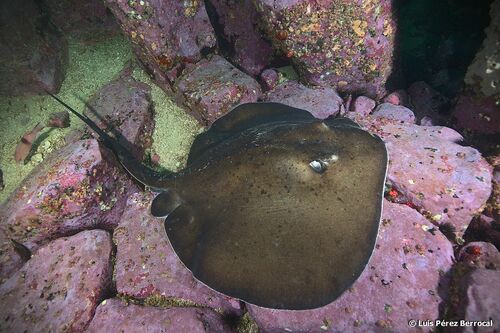
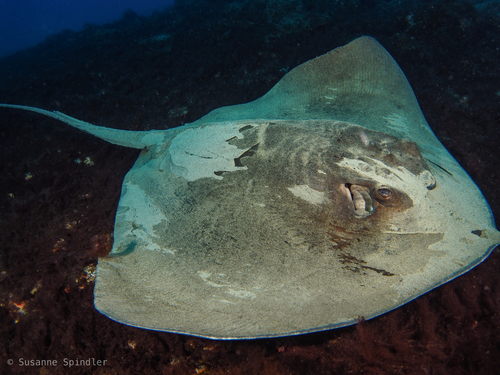
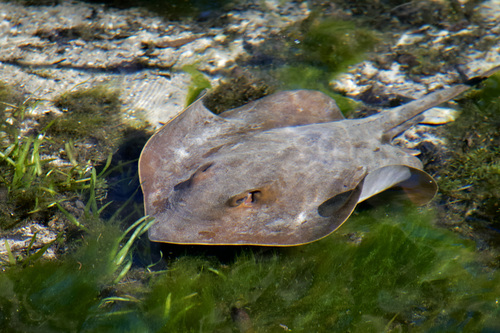
This species is one of the smallest stingrays, with the binomial name Hypanus sabinus (Lesueur, 1824), commonly called the Atlantic stingray. Adults reach a maximum length of 61 cm (24 in) and a maximum weight of 4.9 kg (11 lb). Its pectoral fin disk is spade-shaped, 1.1 times as wide as it is long, with rounded corners and concave front margins. Its snout is relatively long. Three thick papillae sit on the floor of its mouth, and its teeth are rounded with a flat, blunt surface. During the reproductive season, the teeth of mature males change to grow long, sharp cusps that curve toward the mouth corners, to help grip females during mating. The tail is long and whip-like, bearing a serrated venomous spine that is a quarter as long as the disk is wide. This spine is replaced annually between June and October. Both dorsal and ventral fin folds are present on the tail. Larger Atlantic stingrays grow tubercles or thorns along the midline of the back, extending to the origin of the tail spine. Some larger females also develop tubercles around the eyes and spiracles. The upper surface of the body is brown or yellowish brown, lightening toward the disk margin; some individuals have a dark stripe along the midline. The underside is white or light gray, and the tail fin folds are yellowish. In larger individuals, the tail may be gray-flecked near the base and fully dark toward the tip.
The Atlantic stingray occurs in the western Atlantic Ocean, ranging from Chesapeake Bay south to Florida, the Gulf of Mexico, and as far south as Campeche, Mexico. Records of this species from Grenada, Suriname, and Brazil are considered doubtful and likely refer to other species. It can tolerate a wide range of salinities and can enter freshwater; it has been documented in the Mississippi River, Lake Pontchartrain, and Florida's St. Johns River. The population in the St. Johns River system is the only permanent freshwater elasmobranch population in North America. This species lives in shallow coastal waters over sandy or silty bottoms, as well as estuaries and lakes. It prefers water temperatures above 15 °C (59 °F) and can tolerate temperatures over 30 °C (86 °F). It makes seasonal migrations to remain in warm water: it only occurs in the more northerly Chesapeake Bay during summer and fall, and in other areas it migrates to deeper water during winter. When inshore, it usually stays at depths of 2–6 m (6.6–19.7 ft), and after moving offshore it can be found as deep as 25 m (82 ft).
The Atlantic stingray feeds mainly on benthic invertebrates including bivalves, tube anemones, amphipods, crustaceans, and nereid worms, which it locates using electroreceptive ampullae of Lorenzini. The exact composition of its diet varies based on geographical location. When feeding, these rays position themselves facing the current to allow sediment to wash away. Major predators of the Atlantic stingray include multiple shark species, such as the tiger shark (Galeocerdo cuvier) and the bull shark (Carcharhinas leucas). In freshwater habitats, it may be hunted by American alligators (Alligator mississippiensis). A known parasite of freshwater Atlantic stingrays is Argulus, a fish louse that feeds on skin mucus. Though it regularly occurs in freshwater, the Atlantic stingray is physiologically euryhaline, and no population has evolved the specialized osmoregulatory mechanisms seen in the river stingrays of the family Potamotrygonidae. This may be because it colonized freshwater relatively recently, less than one million years ago, and/or because freshwater populations have not become fully genetically isolated, as they still can survive in salt water. Freshwater Atlantic stingrays have only 30–50% the concentration of urea and other osmolytes in their blood compared to marine populations. Even so, the difference in osmotic pressure between the ray's internal fluids and the external environment still causes water to diffuse into the body, so individuals must produce large amounts of dilute urine (at 10 times the rate of marine individuals) to compensate.
Like other stingrays, the Atlantic stingray is viviparous. Both marine and freshwater populations in Florida have an annual mating season that runs from September or October to April, though ovulation does not happen until late March or early April. During courtship, the male follows the female and bites at her body and fins, then grips her pectoral fin to aid copulation. Embryos are supported by a yolk sac until around day 60, after which they are nourished by uterine milk (histotrophy) secreted by the mother. Litters of 1 to 4 young are born between late July and early August, after a gestation period of 4 to 4.5 months. Newborns have a disk width of 10–13 centimetres (3.9–5.1 in). In marine populations, males mature when they reach a disk width of 20 cm (7.9 in), and females mature at a disk width of 24 cm (9.4 in). In freshwater populations, males mature at 21 cm (8.3 in) disk width, and females mature at 22 cm (8.7 in) disk width.