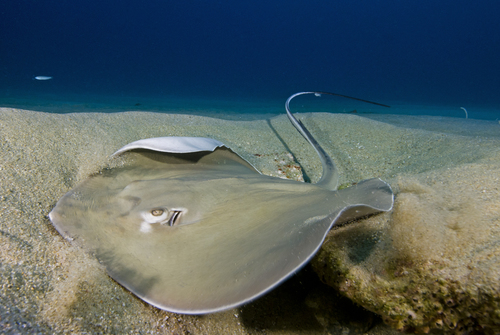
About Hypanus longus (Garman, 1880)
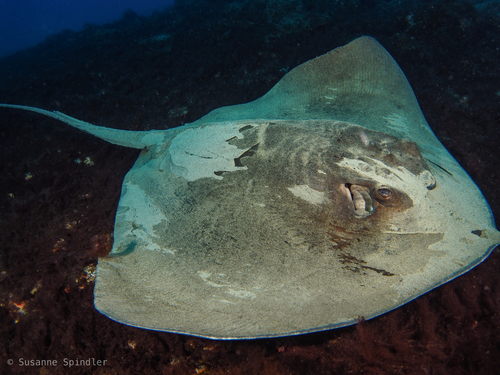
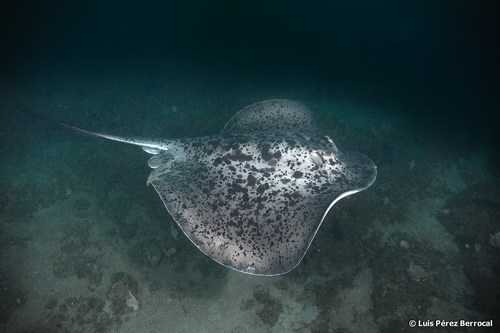
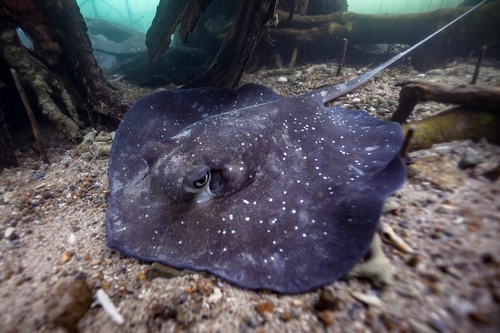
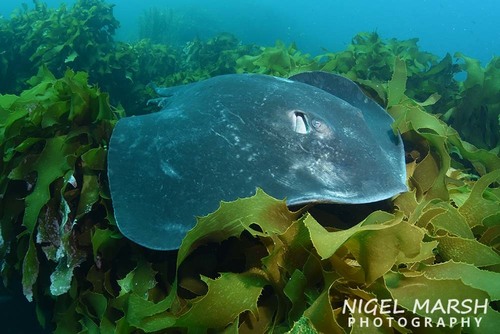
The longtail stingray (Hypanus longus) has a maximum known recorded size of 1.58 m (5.2 ft) across its pectoral fin disc, 2.57 m (8.4 ft) in total length, and 46.4 kg (102 lb) in weight. Its pectoral fin disc is diamond-shaped, around one sixth wider than it is long, with broadly rounded outer corners. The front disc margins are nearly straight, and meet the snout tip at a blunt angle. Across the floor of its mouth runs a row of five papillae; the two outermost papillae are smaller than the other three. Its pelvic fins are rounded. The species has a whip-like tail that measures more than twice as long as its disc, and bears a stinging spine. Behind the spine, the tail becomes laterally compressed, with a low keel on the upper side and a short, narrow fin fold on the lower side. A row of pointed tubercles runs along the midline of the back, from between the shoulders to the base of the tail. Two much shorter rows of smaller tubercles sit alongside the central row behind the shoulders, and slope slightly inward as they extend backward. Numerous small dermal denticles are also present between the eyes, and on the tail behind the spine. Its dorsal (upper) coloration ranges from plain reddish-brown to dark gray, while its underside is pale. Denticle coverage and the number of oral papillae can vary between individual longtail stingrays. This species closely resembles the diamond stingray (H. dipterura), which shares the same geographic range, but can be told apart by the longtail stingray's lack of an upper tail fold. Tail length is not a reliable trait for identifying this species, because longtail stingray tails are frequently damaged. The longtail stingray occurs along the tropical Pacific coast of the Americas, ranging from central Baja California (it may also be found as far north as San Diego, California) south to Colombia. Its range also includes the Revillagigedo Islands and the Galapagos Islands. This species lives on sandy or muddy flats down to a depth of 90 m (300 ft), and is often found near rocky or coral reefs, or within estuaries. In the Galapagos Islands, it has been reported as abundant in the shallow lagoons of mangrove swamps on Fernandina Island. Longtail stingrays are apparently solitary. They are predators that hunt bottom-dwelling bony fishes and invertebrates, especially stomatopods, decapods, and molluscs. Documented parasites of the longtail stingray include the tapeworms Acanthobothrium cimari, A. cleofanus, A. costarricense, A. puntarenasense, A. vargasi, Anthocephalum lukei, A. michaeli, Parachristianella dimegacantha, Pseudochristianella elegantissima, P. nudiscula, and Pterobothrioides carvajali, as well as the monogenean Listrocephalos whittingtoni. Like other stingrays, the longtail stingray is aplacental viviparous: developing embryos are first sustained by yolk, and later by histotroph, also called "uterine milk", produced by the mother. Adult females have only one functional ovary. Near-term females appear to move into shallow estuaries and tidal creeks to give birth, after a gestation period of 10 to 11 months, and may mate again immediately after birth. Litters contain between 1 and 5 young, each newborn measuring roughly 40 cm (16 in) across the disc. Males reach sexual maturity at a disc width of 0.8 m (2.6 ft), while females reach sexual maturity at a disc width of 1.1 m (3.6 ft).