About Hypanus guttatus (Bloch & Schneider, 1801)
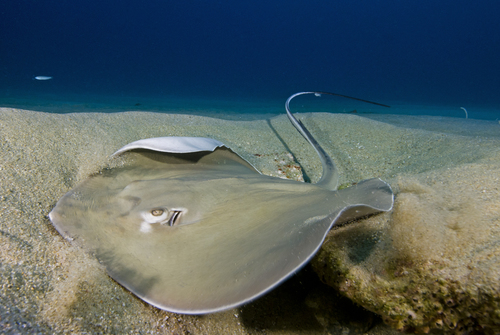
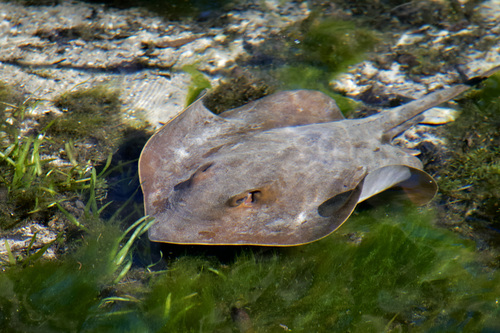
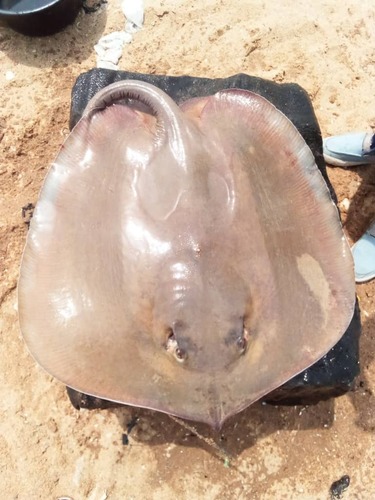
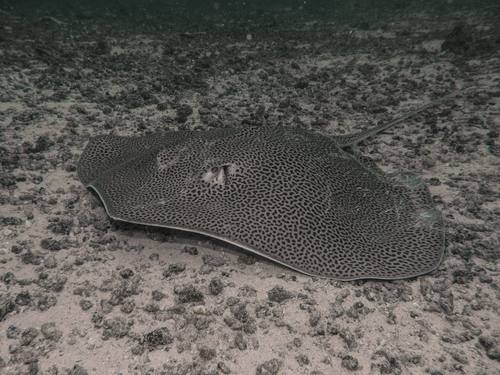
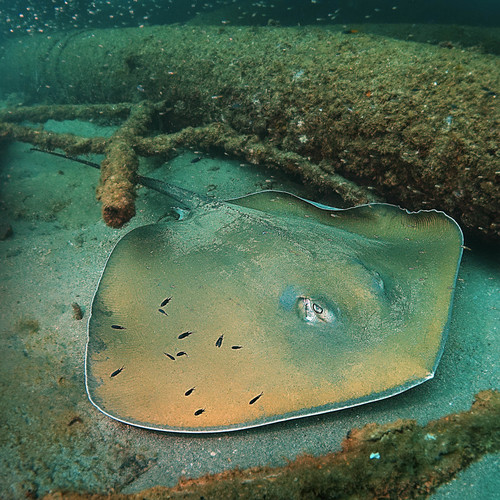
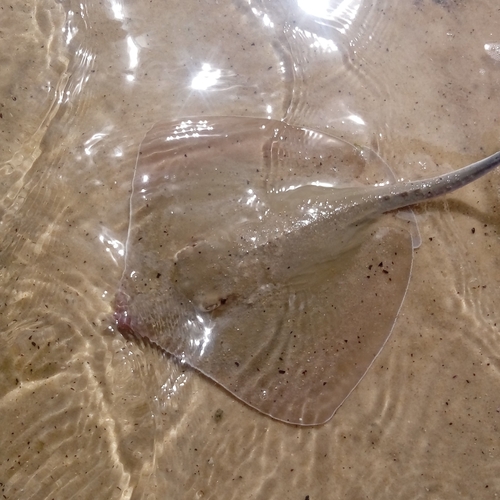
Hypanus guttatus, commonly known as the longnose stingray, has a diamond-shaped pectoral fin disc that is slightly wider than it is long. The outer corners of the disc form roughly right angles, while its gently concave front margins converge to an obtuse, moderately projecting snout. The mouth is curved, with a central projection on the upper jaw that fits into an indentation on the lower jaw. A row of three papillae runs across the floor of the mouth. The upper jaw holds 34 to 46 tooth rows. In females and juveniles, the teeth have tetragonal bases and blunt crowns; mature males have teeth with sharp, pointed cusps. The pelvic fins are rounded. The slender, whip-like tail is much longer than the disc, and usually has one serrated stinging spine near its base, though some individuals have no spine or more than one. Behind the spine, there is a long fleshy dorsal keel, and a ventral fin fold that is two-thirds to four-fifths as tall as the tail. A row of small, blunt thorns or tubercles runs along the midline of the back, from between the eyes to the base of the tail spine. Larger individuals also develop a mid-dorsal band of heart-shaped, flattened denticles. The dorsal surface is colored olive, brown, or gray, sometimes with darker spots, while the ventral surface is yellowish to white; the tail's keel and fin fold are black. This species reaches a maximum known disc width of 2 meters (6.6 feet), though a 1.25 meter (4.1 foot) disc width is more typical, and females grow larger than males. This bottom-dwelling species ranges from the southern Gulf of Mexico south to the Brazilian state of Paraná, and can also be found in the Greater and Lesser Antilles. It inhabits inshore marine and brackish waters from the intertidal zone down to a depth of 36 meters (118 feet). It prefers muddy or sandy substrates, and tolerates a wide range of salinity levels. Longnose stingrays generally fill the same ecological niche as the more northerly Atlantic stingray (D. sabina). Where their ranges overlap, the two species are spatially segregated: longnose stingrays occur at depths of 1 to 15 meters (3.3 to 49.2 feet), while Atlantic stingrays are found at depths up to 50 to 60 meters (160 to 200 feet). This species feeds mainly on benthic invertebrates and small bony fishes, and often uses its pectoral fins to uncover burrowing prey. Its pavement-like teeth allow it to grind up hard-shelled organisms. A study conducted off the Brazilian state of Ceará found the most common prey items to be holothuriid sea cucumbers, peanut worms, eunicid polychaete worms, bivalves, gastropods, the crustaceans Penaeus and Callinectes, and the grunt Pomadasys corvinaeformis. Documented parasites of the longnose stingray include the tapeworms Rhinebothrium margaritense and Rhodobothrium pulvinatum, the isopods Excorallana tricornis and Rocinela signata, and the monogenean Monocotyle guttatae. Like other stingrays, the longnose stingray is aplacental viviparous: developing embryos are first sustained by yolk, and later by histotroph, or "uterine milk", produced by the mother. Females have only one functional uterus, located on the left, and produce two litters of 1 to 2 pups per year, one around March and the other around November. The gestation period lasts 5 to 6 months, and vitellogenesis, or yolk formation, occurs at the same time as gestation. This allows females to ovulate a new batch of eggs and mate again immediately after giving birth. Newborn longnose stingrays have a disc width of 12.3 to 15.3 centimeters (4.8 to 6.0 inches). Birth takes place in water with relatively low salinity, but the young quickly move into saltier half to full-strength seawater. A confirmed nursery area for this species is located off the beaches of Caiçara do Norte in northeastern Brazil, where newborns and small juveniles have been recorded in water no deeper than 3 meters (9.8 feet) from February to October. Very small juveniles have also been observed in tidal pools in Ceará. Males reach sexual maturity at a disc width of 50 to 60 centimeters (20 to 24 inches), while females mature at 60 to 70 centimeters (24 to 28 inches). When sexual maturation begins, longnose stingrays move back into water with salinities of 20 ppt or less; females with a disc width over 75 centimeters (30 inches) are only found in salinities below 5 ppt.