About Hypanus dipterurus (Jordan & Gilbert, 1880)
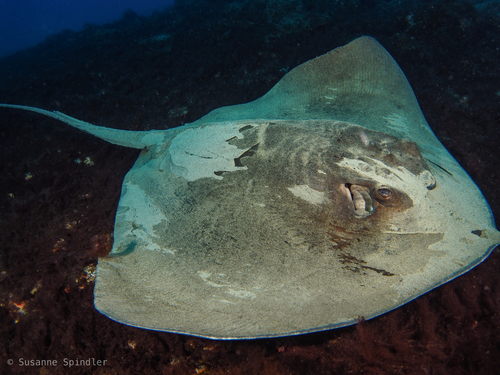
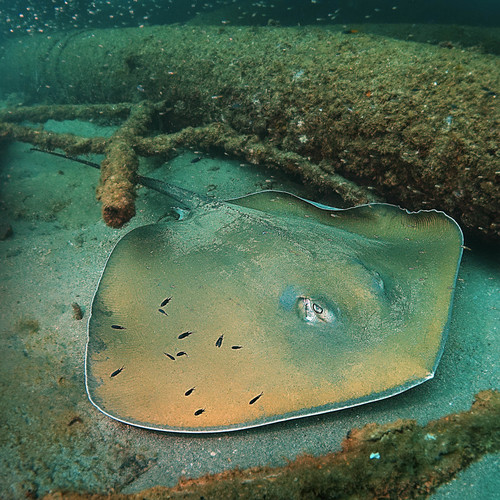
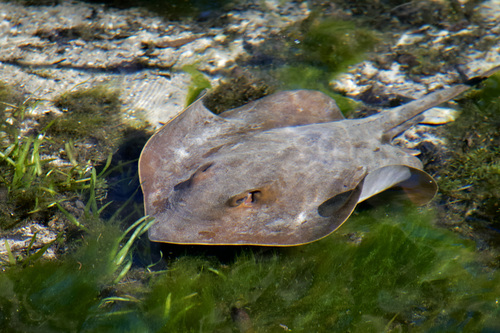
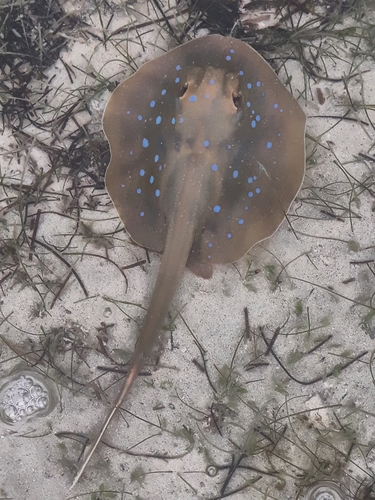
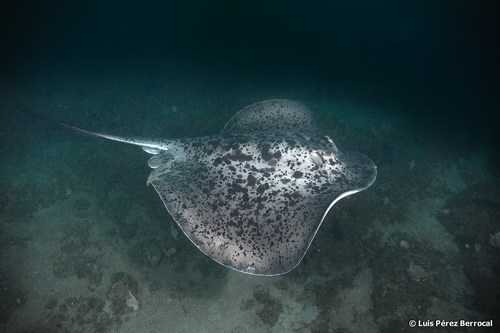
The diamond stingray (Hypanus dipterurus) reaches a disc width of 1 meter (3.3 feet), and may grow as large as 1.2 meters (3.9 feet); females of this species grow larger than males. Its pectoral fin disc has a rhomboid shape, is slightly wider than it is long, and has angular outer corners and subtly convex margins. The snout is blunt-angled and does not protrude. The eyes are fairly large, and paired respiratory openings called spiracles sit immediately behind the eyes. The mouth is strongly curved, and holds 21 to 37 upper tooth rows and 23 to 44 lower tooth rows. The teeth are small and blunt, arranged into flattened surfaces. A row of three or five nipple-like structures called papillae runs across the floor of the mouth. The whip-like tail is generally up to one and a half times as long as the disc, and has one (or more, if replacement spines have grown in) long, slender, serrated spine on its upper surface, positioned closer to the tail base than the tip. Behind the spine, long dorsal and ventral fin folds rise gradually, reach a relatively high apex, then slope down abruptly. The presence of this upper fin fold distinguishes the diamond stingray from the similar longtail stingray (H. longus), which shares most of the diamond stingray's range. However, the tail is often damaged, which makes differentiating the two species in the field nearly impossible. Young diamond stingrays have completely smooth skin, while adults develop a row of low tubercles along the midline of the back, with two shorter rows flanking this row on the 'shoulders'. Prickles also grow to cover the tail in adult individuals. This species is uniformly olive, brown, or gray on its upper surface, darkens to black on the tail, and is off-white on its underside.
The diamond stingray occurs in the eastern Pacific Ocean, ranging from southern California to northern Chile, and is also found around the Galápagos and Hawaiian Islands. It is very abundant around Baja California and in the Gulf of California. At the northern and southern edges of its range, it is generally only present during periods of suitably warm water brought by El Niño. There is an unconfirmed record of this species off British Columbia, which would be highly anomalous, as the diamond stingray is known to be a tropical and warm-temperate species. It is a bottom-dwelling species that lives in inshore waters, and favors sandy or muddy bottoms, often near rocky reefs or kelp forests. Off southern California, it usually occurs from the intertidal zone down to a depth of 7 m (23 ft) during summer, and shifts to depths of 13 to 18 m (43 to 59 ft) during late fall and winter. For unknown reasons, it prefers overwintering in kelp forests rather than on sandy flats. Off Chile, the diamond stingray occurs at a similar depth range of 3 to 30 m (10 to 100 ft). This species has been reported as deep as 355 m (1,165 ft) off Hawaii; if this record is accurate, it suggests the diamond stingray uses a much greater depth range than previously recognized.
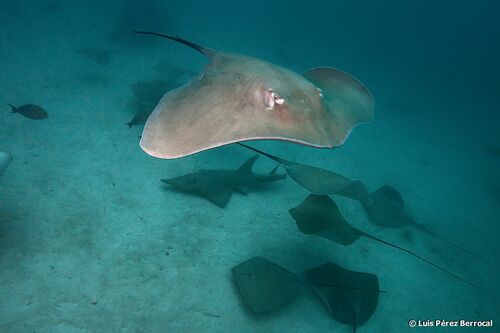
The diamond stingray is most active at night, and spends most of the day buried in sand with only its eyes visible. When foraging, it may be solitary, but more often forms groups of up to hundreds of individuals. There is strong segregation of the population by sex and age. This species feeds on crustaceans, molluscs, other invertebrates, and small bony fishes. Its powerful jaws and molar-like teeth let it crush hard-shelled prey. It mainly targets burrowing organisms, but will also take prey that is exposed on the sea bottom. One record documents a female with a 69 cm (27 in) disc width that had eaten at least 30 small crabs. In the Bahía Magdalena lagoon complex, Baja California Sur, the most important food source for the diamond stingray is pea crabs, followed by the razor clam Solyema valvulus, then polychaete worms. The diamond stingray's typical hunting strategy is to cruise just above the sea floor, and land on top of any prey it encounters. It then quickly levers its body up and down with its disc, creating negative pressure to pull prey out of its burrow. This ray also excavates large pits by undulating its disc and spitting jets of water, to uncover buried prey. Smaller fishes often trail behind diamond stingrays, including Mexican hogfish (Bodianus diplotaenia), Galapagos porgies (Calamus taurinus), greybar grunts (Haemulon sexfasciatum), spinster wrasses (Halichoeres nichols), and long-spine porcupinefish (Diodon holocanthus). These trailing fish eat invertebrates stirred up by the ray's activities. Known parasites of this species include the tapeworms Acanthobothrium bullardi, A. dasi, A. rajivi, A. soberoni, Anthocephalum currani, Parachristianella tiygonis, and Pseudochristianello elegantissima; the flukes Anaporrhutum euzeti and Probolitrema mexicana; and the monogenean Listrocephalos kearni.
Like other stingrays, the diamond stingray is aplacental viviparous: embryos are initially nourished by yolk, and later receive histotroph ('uterine milk', a substance rich in proteins and lipids) produced by the mother. Only the left ovary and uterus are functional in adult females. Several bays along the Pacific coast of Baja California are known to serve as nurseries for the species. Most available life history data for the diamond stingray comes from Bahía Magdalena, where females produce one litter of 1 to 4 pups per year. Courtship and mating occur in late summer, from July to August. Due to a ten-month period of either sperm storage or embryonic diapause (a dormant stage for the embryo), embryonic development does not begin until the following year, and is completed within 2 to 3 months. Birthing takes place in summer, from July to September, in shallow estuaries; newborn rays have a disc width of 18 to 23 cm (7.1 to 9.1 in). Higher temperatures during El Niño years appear to shift the timing of birth earlier. The diamond stingray has the slowest growth rate of any stingray species studied to date. Males reach sexual maturity at a disc width of around 43 to 47 cm (17 to 19 in) and an age of 7 years, while females grow even more slowly, reaching maturity at a disc width of around 57 to 66 cm (22 to 26 in) and an age of 10 years. Maximum lifespan is estimated to be at least 19 years for males and 28 years for females.