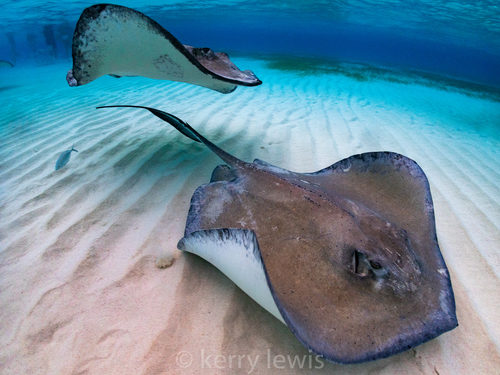
About Hypanus americanus (Hildebrand & Schroeder, 1928)
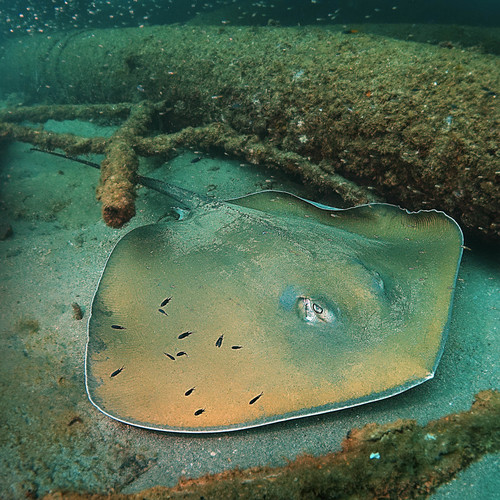
This species, commonly called the southern stingray, has the scientific name Hypanus americanus (Hildebrand & Schroeder, 1928). It is adapted for life on the seabed, with a flattened, diamond-shaped body that is more angular than the bodies of other rays. In adults, the upper surface of the body ranges in color from olive brown to green; juveniles have dark grey upper bodies, and the underside of the body is white all ages. It uses its wing-like pectoral fins to propel itself along the ocean floor. Its slender tail holds a long, serrated, venomous spine at the base for defense. This spine is not fatal to humans, but it causes extreme pain if a person steps on it. The southern stingray's eyes sit on the top of its head, along with small openings called spiracles. This position of the spiracles lets the stingray draw in water while it lies on the seabed or is partially buried in sediment. Water enters through the spiracles and exits through the gill openings, passing around the mouth that is located on the underside of the body. Females grow to a maximum disc width of 150 centimetres (59 in), while males are smaller, reaching a maximum disc width of 67 centimetres (26 in). Hypanus americanus is ovoviviparous: fertilized eggs develop inside the mother's body. Early in development, embryos get nutrients from the yolk sac. After the yolk sac is absorbed, embryos get additional nutrients from histotroph, also called the mother's uterine milk. Females of this species reproduce once per year, and give birth to live young after a typical pregnancy that lasts between seven and eight months. No parental care is provided after the young are born. In captive individuals, gestation lasted between 135 and 226 days, and litters ranged from two to ten young. There is very little published information or research about the mating systems of Hypanus americanus, because mating pairs are very rarely observed in the wild. Only one study has published detailed observations of this species mating: the study documented one female mating with two males, where both males chased the female before one male bit the female's fin, then released her after copulation. Females are able to mate again shortly after giving birth.