About Hyoscyamus niger L.
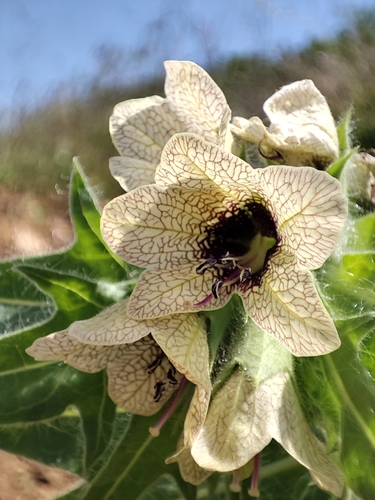
Henbane (scientific name Hyoscyamus niger L., also called black henbane and stinking nightshade) is a poisonous plant in the tribe Hyoscyameae of the nightshade family Solanaceae. It is native to temperate Europe and Siberia, and has become naturalised in Great Britain and Ireland. Originating in Eurasia, it is now grown globally, mostly for pharmaceutical purposes. It is rare in northern Europe, while its cultivation for medicinal use is widespread and legal in central and eastern Europe, and in India. For preparation of henbane, chopped and dried leaves and herbage (without roots) are used for medicinal purposes, in incense and smoking blends, beer making, tea, and wine seasoning. Henbane leaves are boiled in oil to produce henbane oil, and henbane seeds are an ingredient in incense blends. All preparations require careful dosage calculation because of the plant's high toxicity. Some therapeutic applications have used dosages of 0.5 g and 1.5–3 g, but the lethal dosage of henbane remains unknown. Henbane is toxic to cattle, wild animals, fish, and birds. However, not all animals are susceptible: the larvae of some Lepidoptera species including cabbage moths feed on henbane, and pigs are immune to its toxicity and are reported to enjoy the plant's effects. Seeds of henbane from the north-west Himalaya are known to exhibit dormancy. Germination can be triggered by gibberellic acid, nitrates, sodium nitroprusside (SNP), and moist cold stratification. One 2024 study by Sharma observed that fully matured H. niger seeds have dormancy, while comparatively immature seeds germinate well. Immature seeds can be used to propagate henbane without seed pre-treatments. The name 'henbane' dates to AD 1265; the word 'bane' originally meant 'thing that causes death'. Other etymologies trace the name to the Indo-European stem bhelena meaning 'crazy plant', combined with the Proto-Germanic element bil meaning 'vision', 'hallucination', 'magical power', and 'miraculous ability'. Historically, henbane was combined with other plants such as mandrake, deadly nightshade, and datura to make anaesthetic potions and psychoactive 'magic brews'. Its psychoactive effects include visual hallucinations and a sensation of flight. Originally used in continental Europe, Asia, and the Arab world, it spread to England during the Middle Ages. Ancient Roman use of henbane was documented by Pliny, who described it as 'of the nature of wine and therefore offensive to the understanding', and by Dioscorides, who recommended it as a sedative and analgesic. Recorded as Herba Apollinaris, the plant was used by priestesses of Apollo to produce oracles. Claims of its use in earlier British Neolithic have been recently debated. John Gerard's Herball notes that the leaves, seeds, and juice cause prolonged unquiet drunken-like sleep that is deadly to patients when taken internally, and that foot bathing in a henbane decoction or repeated smelling of the flowers causes sleep. The plant was also claimed to be used as a fumigant for magical purposes. Albertus Magnus, in his 1250 work De Vegetalibus, reported that necromancers used henbane to invoke the souls of the dead and demons. As early as the Late Middle Ages, henbane was demonized and became inseparably linked to witchcraft and malefic practices. Perger recorded in 1864 that 'the witches drank the decoction of henbane and had those dreams for which they were tortured and executed. It was also used for witches' ointments and was used for making weather and conjuring spirits. If there were a great drought then a stalk of henbane would be dipped into a spring, then the sun-baked sand would be sprinkled with this'. Henbane was found among imported spices during underwater archaeological excavation of the royal Danish-Norwegian flagship Gribshunden, which sank in 1495 near Ronneby, Sweden. The purpose of this henbane is unknown, but it could have been used medicinally to soothe toothache, act as an anti-emetic, or prevent motion sickness. In a 1538 Pomeranian witchcraft trial, a suspected witch 'confessed' that she had given henbane seeds to a man to make him run around 'crazy' (sexually aroused). Marzell recorded in 1922 that an Inquisition trial file noted 'a witch admits' to once scattering henbane seeds between two lovers and saying 'Here I sow wild seed, and the devil advised that they would hate and avoid each other until these seeds had been separated'. Henbane was one of the ingredients in gruit, the traditional flavouring for beer. A recipe for henbane beer uses 40 g dried chopped henbane herbage, 5 g bayberry, 23 L water, 1 L brewing malt, 900 g honey, 5 g dried yeast, and brown sugar. It stopped being used in beer after being replaced by hops between the 11th and 16th centuries; in Bavaria, the 1516 Purity Law outlawed all beer ingredients other than barley, hops, yeast, and water. Henbane is sometimes suggested to be the 'hebenon' poured into the ear of Hamlet's father, though other candidates for hebenon exist. In modern traditional herbal medicine, henbane is used to treat bone ailments, rheumatism, toothache, asthma, cough, nervous diseases, and stomach pain. It may also be used as an analgesic, sedative, and narcotic in some cultures. Adhesive bandages with henbane extract worn behind the ear are reported to prevent discomfort from travel sickness, and henbane oil is used for medicinal massage. In most Western countries, henbane products are only available in pharmacies with a prescription. In the United States, sales of henbane oil are not legally regulated and are allowed in shops other than pharmacies. Henbane has been spread in part through travel with Romani people.