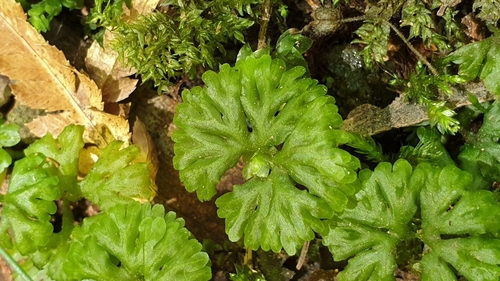
About Hymenophyton flabellatum (Labill.) Dumort. ex Trevis.
Hymenophyton flabellatum (Labill.) Dumort. ex Trevis. has plagiotropic, branched rhizome-like axes, with aerial shoots divided into upright stalks. Its palmate or flabellate fronds are olive green, and fork 5 to 6 times. The forked thallus wings spread horizontally. Segments are flat, with slightly wavy edges, measuring 0.8 to 1.2 mm wide. Segments have obtuse apices and show limited growth. The growing apex holds 1-celled marginal slime papillae. Lamina cells are 35-49μm long, 23-30μm wide, and 23-35μm thick. Marginal cells are shorter, 18-23 μm in length and 33-35μm in width. Each frond produces 3 to 4, or 5 to 6 male branches, which grow laterally on the stalk or nerve bifurcation. The female scale has a toothed margin. Species in the genus Hymenophyton produce spores that are dispersed via an elongated, spirally thickened structure called elaters. The central strand of Hymenophyton flabellatum contains long, axially elongated water-conducting cells with pointed ends. Mature water-conducting cells lack living contents, and their thickened walls have oblique slit-shaped depressions. Adjacent cells connect through small perforations located within these depressions. Hymenophyton flabellatum is commonly found in New Zealand, Australia, Tasmania, and Chile, growing in rain forest and wet forest habitats. It grows on shaded wet soil, humus, and old logs within forests, and along river banks. The 2010 Bush Blitz survey reported the presence of Hymenophyton flabellatum at two locations in Tasmania: Seventeen Mile plain and Vale of Belvoir reserves. An additional report recorded the presence of this liverwort at the Teepookana forest site in Tasmania, where it was found growing on a fallen portion of an old Huon pine tree.

