About Hymenophyllum tunbrigense (L.) Sm.
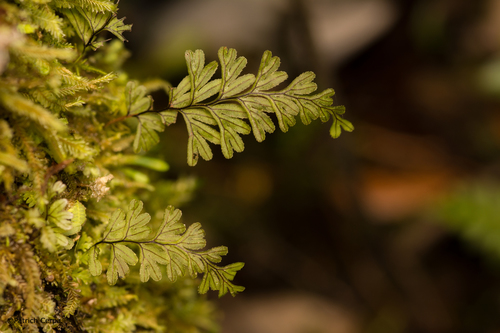
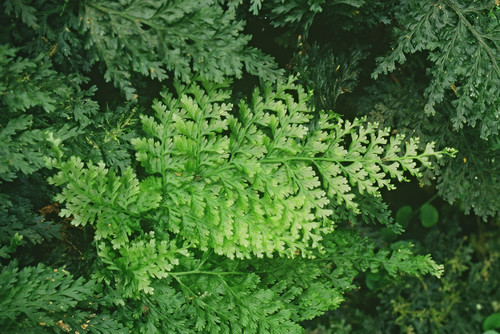
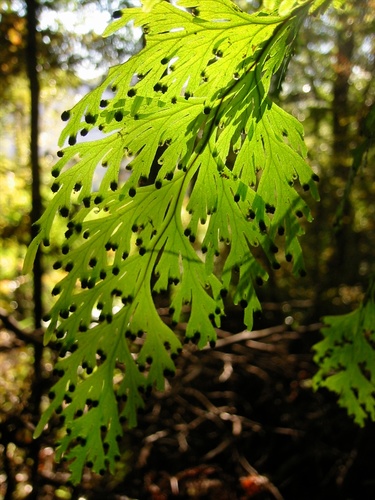
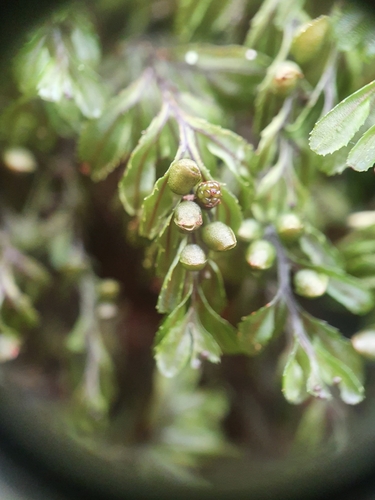
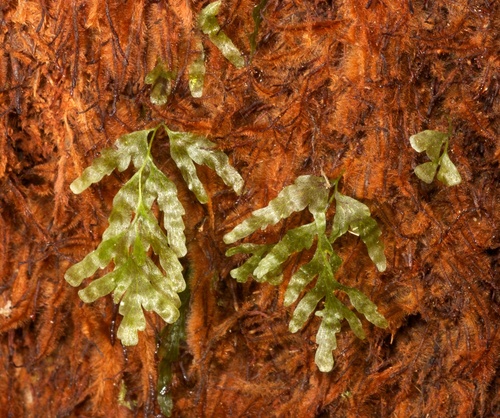
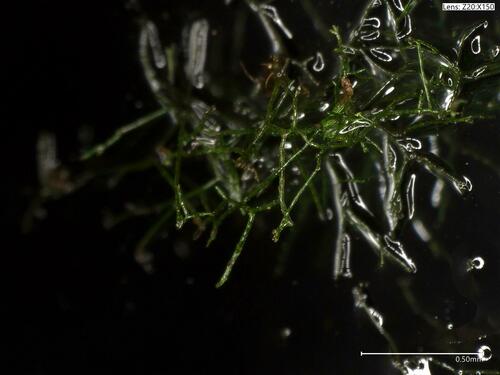
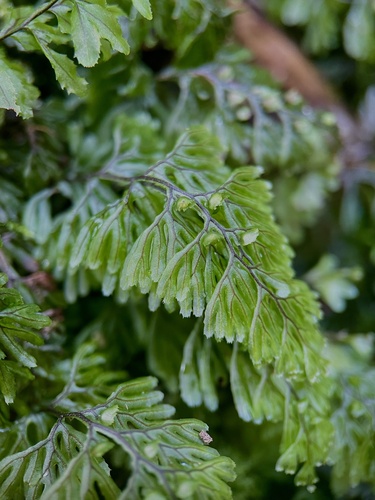
Hymenophyllum tunbrigense (L.) Sm., commonly known as the Tunbridge filmy fern or Tunbridge filmy-fern, is a small, fragile perennial leptosporangiate fern. It grows large dense colonies of overlapping leaves from creeping rhizomes. Its common name comes from its extremely thin leaves, which are only one cell thick and translucent, giving them the appearance of a wet film. The evergreen fronds of this fern are bipinnatifid, deeply and irregularly dissected. They measure about 3 to 6 cm long and 2 cm across, and have dark winged stipes. Compared to the similar species H. wilsonii, H. tunbrigense fronds are more divided, flattened, appressed to the substrate, and typically have a bluish tint. Its fronds are monomorphic, and produce sori along the frond segments close to the rachis. Each frond produces up to 5–10 purse-shaped sori, and each sorus is covered by two strongly convex, flattened indusial valves. The jagged margins of these valves distinguish H. tunbrigense from H. wilsonii, which has entire indusial valve edges. Like all ferns, H. tunbrigense has a gametophyte stage in its life cycle via alternation of generations, and develops a haploid reproductive prothallus that grows as an independent plant. There is little published information about this species' gametophyte, but it is thought to be inconspicuous with a narrow ribbon-like thallus. The gametophyte may be able to reproduce vegetatively by gemmae when the sporophyte is not present. Gametophytes of the related Killarney fern (Trichomanes speciosum) have been found growing outside the geographical range of that species' sporophyte, and this may also be the case for Hymenophyllum tunbrigense. This species has an apparently discontinuous worldwide distribution, and is most frequent in western European oceanic regions such as the British Isles. There is ongoing uncertainty about whether similar plants found in Mexico, the West Indies, Central America, South America, South Africa and Asia should also be classified as H. tunbrigense. H. tunbrigense has a similar but distinct distribution to H. wilsonii, and also occurs in North America. Its specific habitat preference means it has likely been under-recorded across many less densely populated regions of the world. In continental Europe, H. tunbrigense occurs much further east than H. wilsonii, but these eastern sites are very disjunct and may represent relict populations left over from an earlier different climatic period. Many of the continental European populations of this species have declined or disappeared in recent decades. This species' specific epithet is derived from Royal Tunbridge Wells in Kent, England, which was one of its disjunct eastern localities in Britain. Filmy ferns in the genera Hymenophyllum and Trichomanes are very vulnerable to desiccation, which limits the habitats where they can survive. Hymenophyllum species depend just as much, or even more, on a site's microclimate than on its macroclimate. H. tunbrigense is most commonly associated with rock outcrops, especially when the outcrops have deep fissures or crevices. Hymenophyllum tunbrigense appears to not reproduce effectively from spores under current environmental conditions. Gametophytes have not been formally identified in the field for this species, though there is circumstantial evidence that sexual reproduction still occurs. There are historical records of H. tunbrigense being cultivated, including when Harold Stuart Thompson grew a specimen collected from Somerset in a bell jar in his bedroom for a decade, but the species is not generally cultivated. It is propagated at Kew Gardens for reestablishment in suitable wild habitats.