About Hymenophyllum nephrophyllum Ebihara & K.Iwats.
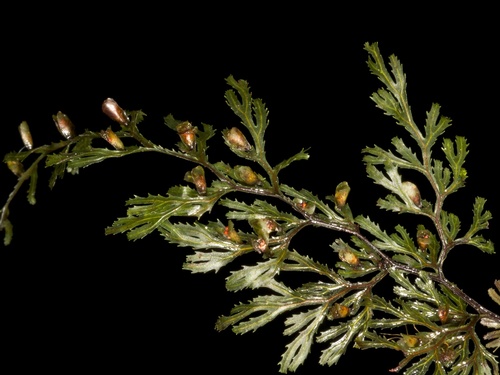
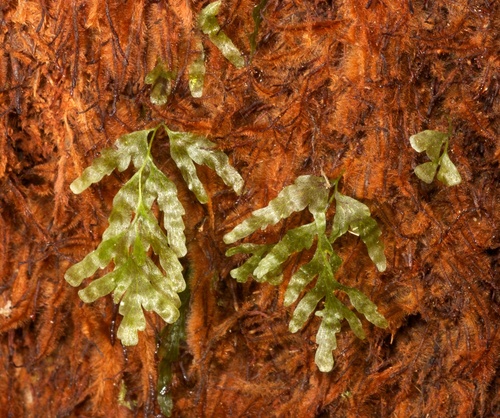
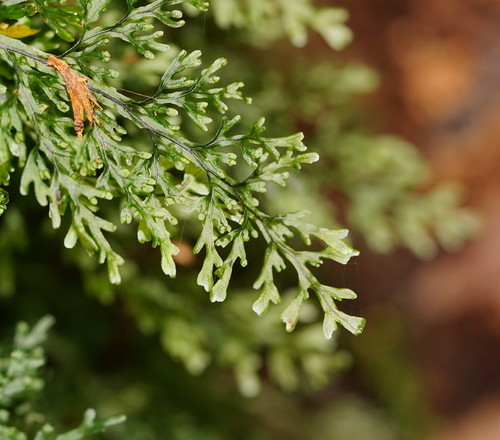
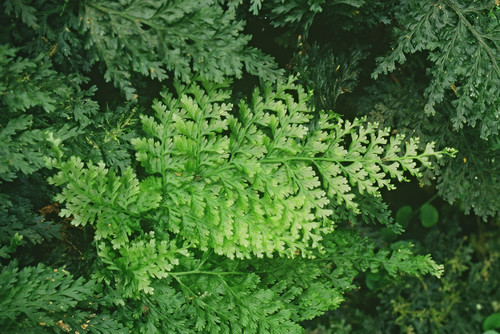
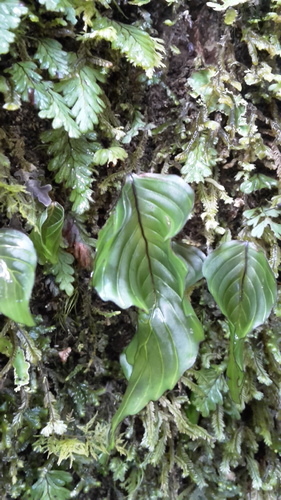
Hymenophyllum nephrophyllum Ebihara & K.Iwats. is a fern with undivided, kidney-shaped fronds that give it its English common name, kidney fern. Its fronds, also called laminae, measure 3–10 cm by 4–13 cm and are a shiny, translucent green. This translucency comes from the fronds being extremely thin: sporelings have just one cell layer, while mature plants have 3–4 cell layers. Fronds are held on brittle stipes that are 5–25 cm long. Mature kidney ferns grow a row of sori (clusters of sporangia) along the upper edge of their fronds, where these structures look like a row of small brown pegs. Like some other filmy ferns, Hymenophyllum nephrophyllum can curl tightly during dry conditions to cut down on moisture loss. This trait gives it one of its Māori common names, kopakopa, which means to wrap or clasp. The plant unfurls and recovers once rain returns or conditions become more favorable. This fern species is endemic to New Zealand, meaning it is native to and only occurs naturally in this country. Other species in the genus Hymenophyllum grow both in New Zealand and across the rest of the world. Within New Zealand, Hymenophyllum nephrophyllum occurs across the entire North Island, in the northern, western, and southern regions of the South Island, and also on Stewart Island and the Chatham Islands. It has never been recorded growing on the eastern side of the South Island. It can be found in a broad range of habitats, from wet forests to lava fields, but it occurs most often in moister forests at altitudes up to 780 meters. Its absence from most of the eastern South Island is likely due to its preference for moist forest environments, while its curling adaptation to drought lets it tolerate a wide variety of habitats. Hymenophyllum nephrophyllum grows on forest floors, where it often forms large continuous mats. It also grows on banks, rocks, fallen logs, and as an epiphyte on the lower trunks and branches of trees. Like all ferns, Hymenophyllum nephrophyllum reproduces and disperses new offspring via spores. It has tubular indusia, which are structures that protect developing spores; these indusia extend outward from the edges of the fronds. Sori-carrying stalks, with sporangia that mature sequentially from the base to the apex, grow out of the indusia. When the plant reaches maturity, these stalks emerge and release their spores. Hymenophyllum nephrophyllum also spreads through vegetative reproduction: it produces far-creeping rhizomes, which are underground stems that grow new adventitious shoots and roots. These rhizomes form the characteristic dense mats of kidney fern fronds seen on forest floors. Few other plant species grow within these mats, because the rhizomes of Hymenophyllum nephrophyllum produce a chemical compound that inhibits root growth in the seedlings of other species.