About Hymenophyllum dilatatum (G.Forst.) Sw.
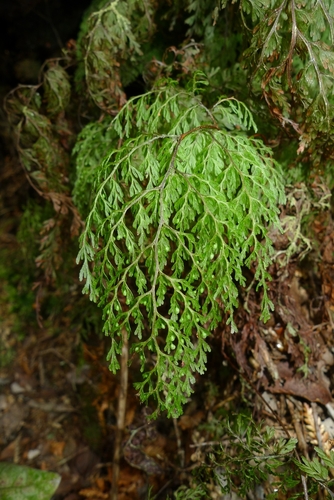
Hymenophyllum dilatatum (G.Forst.) Sw. is a pteridophyte (fern). This species is distinctive among other Hymenophyllum species for its typically thicker fronds, which are often up to 2-3 cells thick. It has long, creeping rhizomes that store nutrients and enable vegetative reproduction. These rhizomes are 1-1.5 mm in diameter, and covered in 2 mm long, thick red-brown hairs. Its stipes are widely spaced on the rhizomes, between 10–150 mm (0.39–5.91 in) long, and can be brown or green. They are distinctly winged and narrow for at least half of their length, and either have very few hairs or are completely glabrous (hairless).
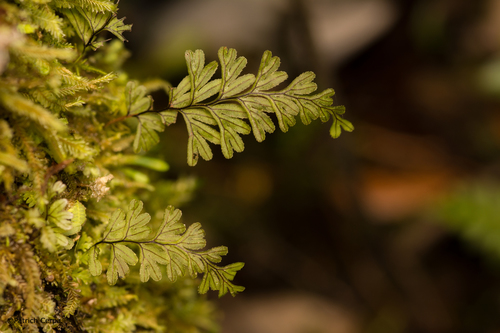
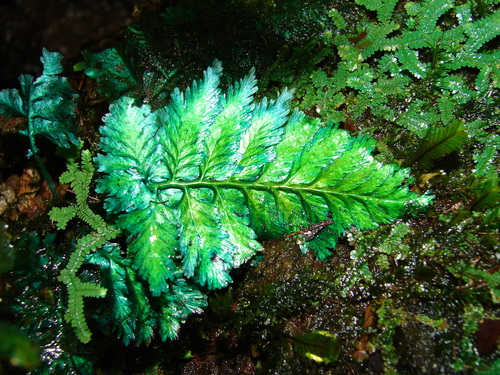
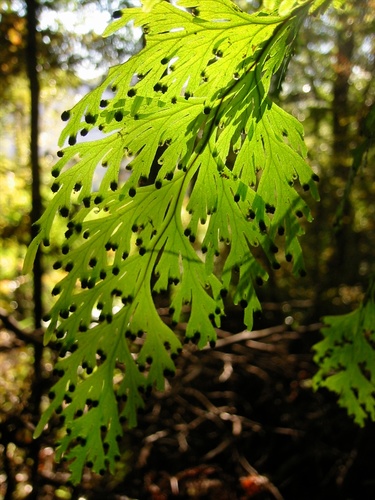
Fronds of Hymenophyllum dilatatum are filmy and translucent, colored bright to dark green, and 60–570 mm (2.4–22.4 in) long. The laminae (leaf blades) measure 45–450 mm (1.8–17.7 in) long and 40–170 mm (1.6–6.7 in) wide. Fronds are divided into 3-4 pinnate leaflets, which are ovate or lanceolate with smooth margins. Sporangia are grouped into dome-shaped sori (spore-producing and containing structures), which occur solitary on leaflets and are partially sunk into the lamina.
Hymenophyllum dilatatum can be easily distinguished from all other Hymenophyllum species by its glabrous, entire-margined fronds, winged stipe, and very broad pinnae segments. This species is endemic to New Zealand. Within New Zealand, it is widespread across most of the North Island, except for the east coast, where it is largely absent. On the South Island, it is mostly confined to the west coast of the main divide in coastal, lowland and montane areas with higher moisture content. There are a few very isolated populations around Dunedin, the Southland Region and The Catlins district. It is also found on Stewart Island, Chatham Islands and Auckland Islands. It does not occur in the drier regions of the interior and eastern South Island. While there have been some observation reports around Banks Peninsula, no voucher specimens have been found there. Distribution of H. dilatatum throughout New Zealand based on verified specimens is illustrated in a figure referenced in the source.
Hymenophyllum dilatatum grows in humid, temperate, rainforest environments. It is usually found in Kauri, podocarp, beech and broadleaved forests, at altitudes ranging from sea level to over 1,060 metres (3,480 ft). It primarily grows as an epiphyte, which typically gives the advantage of increased light supply; however, this species tends to grow in shaded parts of forests and does not need increased light. Tree branches and leaves direct rainwater to the epiphyte, which benefits H. dilatatum, as it prefers moist conditions. It can also be found growing on fallen logs, and occasionally on rock faces. It is very rarely found growing as a terrestrial fern; when terrestrial, it typically grows in rich humus soil, which is the same type of organic matter that forms and collects on tree trunks. Humus contains mycelia that aid epiphyte establishment, as the plant can use fungal hyphae to assist with absorption of water and nutrients.
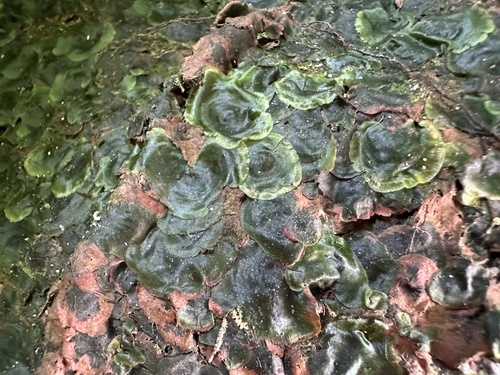
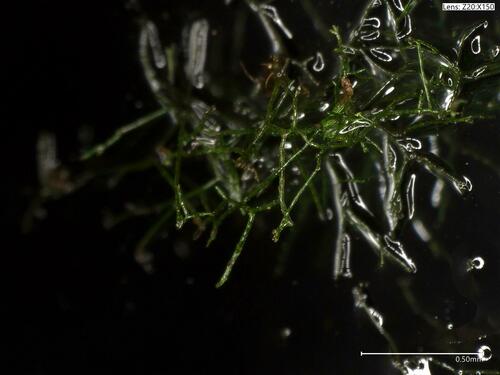
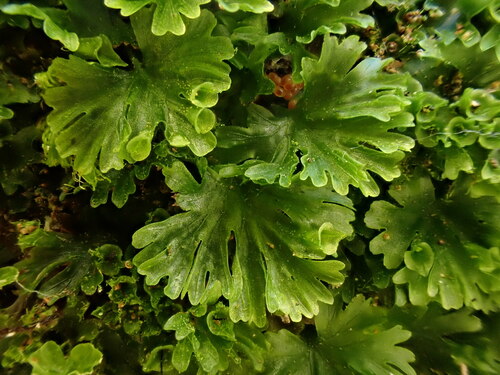
All mature fern fronds contain spores that are dispersed through multiple means, and spores are the main source of population dispersal for the species. Ferns use these spores to reproduce both sexually and asexually. For sexual reproduction: when a released spore germinates, it enters the gametophyte stage where sexual reproduction begins. A germinated spore grows into a prothallus (plural prothalli), a small heart-shaped plant less than a centimeter long with no true complex structure. Prothalli anchor where they land, connected by small hair-like strands, and produce sex organs on their underside. When the male antheridium bursts, it releases sperm that swim towards chemical attractants released by the female archegonia. Fertilisation occurs when a sperm cell enters the archegonium and fuses with the egg cell. The fertilized egg then develops into a new sporophyte fern plant.
For asexual reproduction, both gametophytes and sporophytes are capable of vegetative reproduction, which does not require moisture to succeed. Small plants called bulbils grow directly out of cells on the surface of the parent frond. After detaching, they develop rhizomes and attach to a new surface. They are genetically identical to the parent fern.