About Hymenophyllum australe Willd.
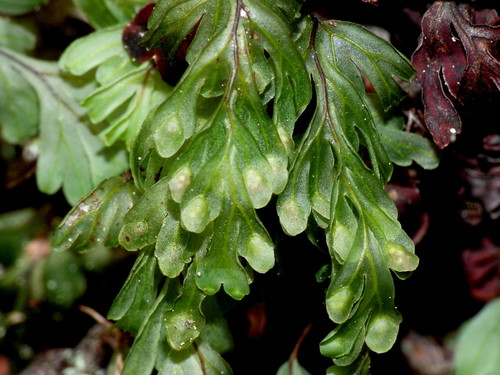
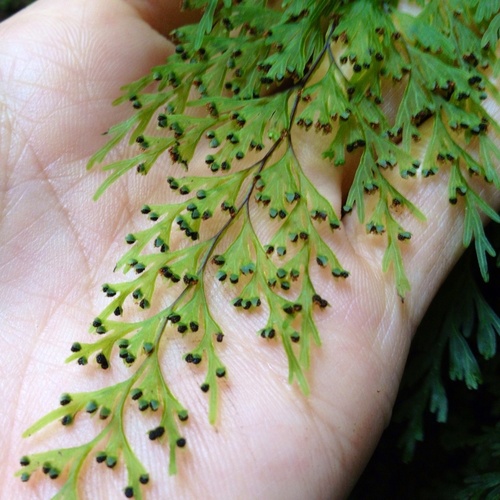
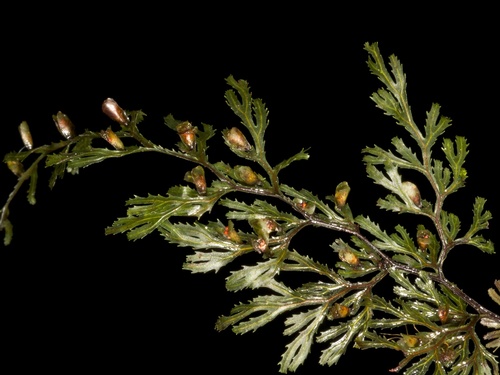
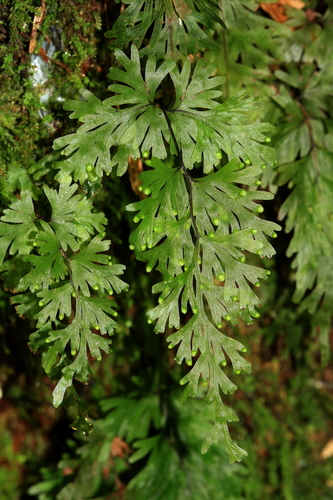
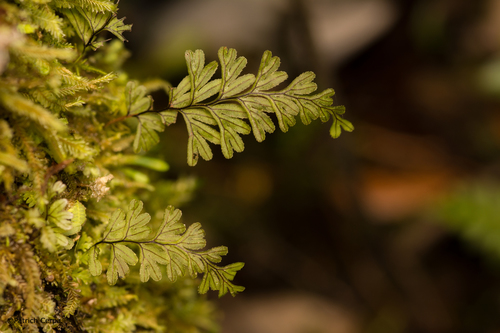
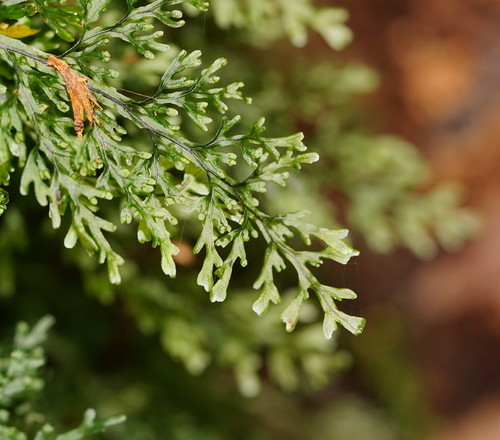
Hymenophyllum australe Willd. is a species of filmy fern that grows either on rock (rupestral) or as an epiphyte. Its rhizomes are long-creeping, fine, typically 0.2–0.5 mm in diameter, branched, and bear scattered bare hairs that are usually clustered near the base of the stipe. Stomata are absent in this species. As is characteristic of the Hymenophyllum genus, its sori grow at the tip of leaf segments, are covered by a two-lipped protective indusium that often has notched margins. The sori are numerous, and are borne either singly or in pairs. The receptacle is short and remains enclosed within the indusium flaps. This species is homosporous; its spores are trilete, greenish, and slightly roughened. Stipes grow at intervals along the rhizome, are winged almost all the way to their base, and are often crinkled. Fronds are dark green, dull, and membranous, ranging from 38 to 210 mm in length. They are triangular to ovate in shape and range from pinnate to tripinnate in division. Rachises are winged, glabrous, dark brown towards their base, and pale brown towards their tip. Ultimate lamina segments are narrowly oblong with a spreading, finger-like appearance, have entire margins, and each contains a single conspicuous vein.
Hymenophyllum australe is a common fern in eastern Australia, where it grows primarily in rainforests and fern gullies. In Victoria, it occurs from the Otways through to Gippsland; it was formerly present on the Mornington Peninsula, but is now considered extinct there due to bushfires. It is also found in Tasmania, southern Queensland, and New South Wales, particularly in the Blue Mountains area. The species also occurs on both the North and South Islands of New Zealand, where it is less common than it is in Australia. Individuals in Tasmania and New Zealand typically have smaller frond wings and less wrinkled segments than Australian populations.
As filmy ferns, Hymenophyllum australe has thin, delicate fronds, so it is restricted to wet or misty areas. The species lacks strengthening tissues in its fronds, so it is entirely dependent on water pressure to maintain turgidity, and will shrivel and collapse quickly in dry air. Because of this, it grows best where air is consistently moist. In New Zealand, Hymenophyllum australe is almost entirely restricted to growing on rocks, or rarely low on tree trunks, in shaded locations either partially submerged or close to flowing water. It has an almost rheophytic habit and is rarely found far from waterways. In Australia, by contrast, the species occupies a much broader range of habitats, growing on rocks further from water and also occurring as an epiphyte. It is common in wet forests, and regularly forms dense covering curtains on tree trunks, logs, wet rocks, and cave walls where sufficient light is available. In Australia, Hymenophyllum australe has a strong association with tree fern trunks, and commonly grows on tree ferns from top to bottom. In Tasmania, the species shows a significant preference for growing on the trunks of the more abundant Dicksonia antarctica over the rarer Cyathea cunninghamii tree ferns.
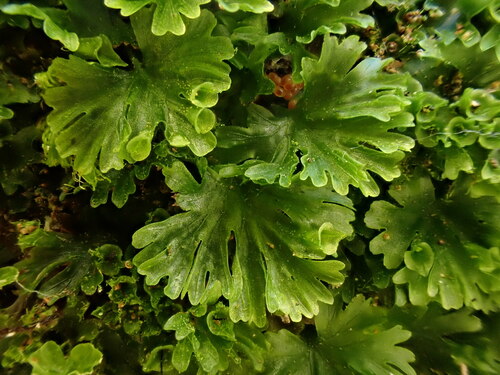
Like all ferns, Hymenophyllum australe has a life cycle with two distinct phases: a small haploid gametophyte stage that grows from spores and produces gametes, and a larger diploid sporophyte stage that produces spores from sporangia. The gametophytic generation starts when spores are released from sporangia on a sporophyte frond. Under favourable conditions, which include adequate moisture, temperature, pH, and light intensity, spores germinate and develop into a filamentous prothallus (the gametophyte). The prothallus of Hymenophyllum australe, like that of all Hymenophyllum species, is long and narrow, and is often described as ribbon-like. This shape differs from the typical heart-shaped prothallus found in most other ferns. Archegonia are borne on sporadic marginal archegonial cushions along the prothallus, while antheridia grow on slender branches at the basal margins of the prothallus. When water is present, spores follow the typical fern germination sequence: antheridia trapped under the prothallus burst to release sperm cells. The archegonia release a chemical signal that attracts motile sperm through chemotaxis. Once a sperm reaches an archegonium, the archegonium opens to allow the male gamete to travel to the ovum, where fertilization occurs to form a zygote. The diploid zygote develops into an embryo and then into the sporophyte, the easily recognizable 'true fern' stage, while the embryo remains embedded in the prothallus. The sporophyte is nutritionally dependent on the prothallus (parasitic) until it grows its first roots and leaves, after which it becomes independent and the prothallus dies. The life cycle is complete once the mature sporophyte produces spores. As with all ferns, free water is required for successful sexual reproduction, as gamete fusion depends entirely on available water.
Both gametophytes and sporophytes of Hymenophyllum australe can reproduce asexually through vegetative reproduction. In the gametophyte stage, this usually occurs by growing new prothalli from older prothalli, but it can also happen through gemmae, a specialized structure for vegetative propagation. Adverse growing conditions such as drying promote abundant gemma formation, because vegetative reproduction does not require gamete fusion and therefore does not require water to proceed.