About Hymenaea stigonocarpa Mart. ex Hayne
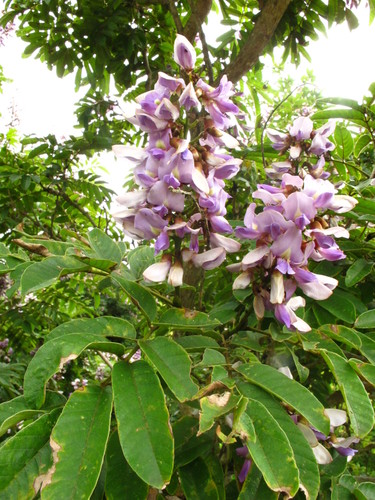
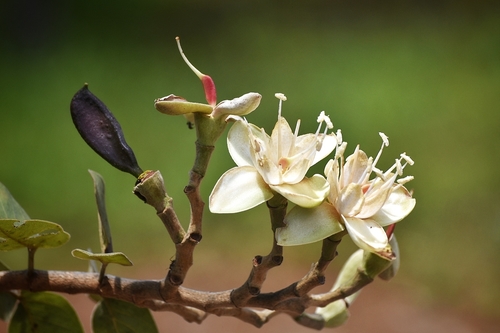
Hymenaea stigonocarpa Mart. ex Hayne has 24 chromosomes (2n=24). It is a low to medium height deciduous tree, reaching 5–20 m (16–66 ft) in height and up to 50 cm (20 in) in diameter at breast height. It has a twisted trunk covered by thick, rough grey bark, and reddish-brown twigs. Its leaves are alternately arranged, and consist of two leathery leaflets that are kidney-shaped to ovate, measuring 6–24 cm (2.4–9.4 in) long and 3.5–7 cm (1.4–2.8 in) wide. Stipules, the bracts at the base of the leaves, fall off quickly. The flowers of this species are the largest in the Hymenaea genus, with petals that are somewhat larger than the sepals. The five thick sepals bend outward after the flower opens. The five white petals are approximately 22 mm (0.87 in) long and 12 mm (0.47 in) wide, attached to the edge of a broad hypanthium. Ten free, white filaments, 40 mm (1.6 in) long, are each tipped by a 9 mm (0.35 in) long anther. In the center of the hypanthium sits a single fleshy carpel on a short 6–8 mm (0.24–0.31 in) stalk, tipped with a long curved white style implanted at an angle, which ends in a bud-shaped, wet, grainy stigma. Inflorescences holding up to 30 flowers form at the tips of branches, with bracts beneath each flower. This species depends on cross-pollination, and is mainly pollinated by bats. Self-fertilised flowers are aborted one week after pollination. The ripe fruit is a dry, indehiscent, leathery legume that ranges from light to dark brown, marked by small regularly spaced light glands. It measures 9–20 cm (3.5–7.9 in) long, 2–6.5 cm (0.79–2.56 in) wide and 2–4.3 cm (0.79–1.69 in) thick, with a rounded base, slightly pointed tip, and straight or wavy margin. The mesocarp and endocarp develop into a yellowish, soft, fibrous, slightly sweet flour-rich pulp with a characteristic scent. A prominent suture line runs around the entire legume. Fruits ripen between April and July in Brazil's Federal District, between July and November in Mato Grosso do Sul, and in August in Minas Gerais. Each fruit holds 1 to 6 seeds. These seeds are reddish-brown, oval, compressed sideways, 18–28 mm (0.71–1.10 in) long and 9–20 mm (0.35–0.79 in) thick, with rounded tips and bases, an irregular surface and small depressions. Overly ripe fruits give off an unpleasant smell. Hymenaea stigonocarpa occurs in northern, central, and eastern Brazil, and in Paraguay. Its nectar-rich flowers open at night. They are pollinated by several bat species, including the mostly fruit-eating Platyrhinus lineatus and Carollia perspicilata, and nectar specialist Glossophaga soricina. Hawkmoths also visit the flowers regularly, but do not appear to be effective pollinators. Self-pollinated seeds do not reach full maturity. While pollen from the same flower grows tubes and fertilizes ovules just as successfully as pollen from another individual, self-pollinated fruits drop from the tree after seven to eight days. The mechanism that triggers this abortion of self-pollinated fruits is not yet known, but cross-fertilised ovules grow faster from the very beginning of development. By producing large annual crops of fruit that are consumed by terrestrial wildlife, the species plays an important ecological role. It has been suggested that agoutis are responsible for most seed dispersal of H. stigonocarpa. Unlike many other species in the plant family Fabaceae, Hymenaea stigonocarpa is reported to lack symbiotic soil bacteria, and thus cannot directly use nitrate that bacteria produce from atmospheric nitrogen. Locally known as Jatobá do cerrado, this tree is important to people living in the Brazilian Cerrado, and holds substantial economic value for its high-quality wood, resin, and edible fruits. The fruits can be used to make flour, and are processed into a variety of foods. As demand for this plant's products grows, there is a need for commercial cultivation and production of high-quality seedlings. Jatobá do cerrado fruit pulp contains around 5.5% protein, and nearly 50% high-fibre flour made up of 40% non-soluble fibre and around 9% soluble fibre. Locals in the Cerrado value flour made from jatobá, and use it to prepare jelly, liqueur, cakes, breads, and porridge. Resin from the stems of jatobá do cerrado is used to polish canoes and produce varnishes. Researchers have found large genetic variation between and within subpopulations that corresponds to variation in fruit weight, which offers potential for breeding varieties with more favorable traits for human use. Seedlings can be grown in plastic bags with 50% shading, and grow best in mineral soil without organic compost when kept in a greenhouse. H. stigonocarpa grows best in a sunny location, and prefers well-drained soil. Once established, the trees are moderately drought resistant. Overall, this species grows slowly. Jatobá do cerrado is sometimes planted as an ornamental tree. One study found that extracts of H. stigonocarpa suppressed cell division in onions, suggesting that the plant may contain cytotoxic substances.