About Hylotelephium spectabile (Boreau) H.Ohba
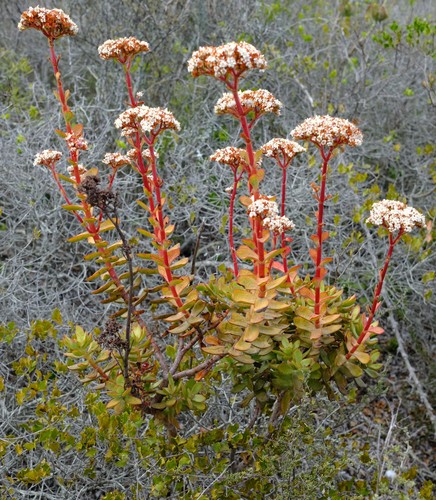
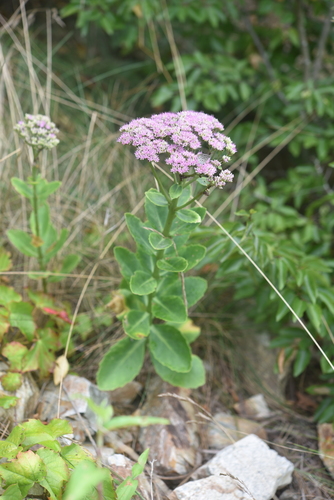
Hylotelephium spectabile (Boreau) H.Ohba is an herbaceous perennial that grows 45 cm (18 in) tall and broad. It has erect, unbranched succulent stems, alternate simple toothed leaves, and a tuberous rhizome. Its leaves are typically arranged oppositely or in groups of three; they are simple, more or less wedge-shaped at the base, frosted blue on the upper surface, 2.5 to 10 cm long, and 0.8 to 5 cm wide. Leaf margins are smooth or serrated toward the tip, and stipules are absent. Star-shaped pink flowers grow in flat cymes 15 cm (6 in) across, blooming from summer until the first frost. This many-flowered cymose inflorescence is 7 to 11 cm wide. The hermaphrodite, radially symmetrical flowers are about 1 cm in diameter and usually five-parted. Sepals are approximately 1 cm long. Petals are usually 6 to 8.5 millimeters long, rarely only 5. There are two whorls of stamens 6 to 8 mm long, which are noticeably longer than the petals, with purple anthers. Free carpels are about 3 mm long, and the style is around 1.2 mm long. This self-fertile species is pollinated by insects. Its specific epithet spectabile means "showy". Hylotelephium spectabile is valued in cultivation, and many cultivars have been developed. The species itself and the cultivar 'Brilliant' have both received the Royal Horticultural Society's Award of Garden Merit. It was introduced to France in the mid-1860s. It grows easily in pots, and is widely used in decorative beds, particularly rock gardens, or in containers; it is very widespread in cultivation in China. Its flowers are used by florists in bouquet arrangements. It prefers full sun, is drought tolerant and cold tolerant, surviving down to −15 °C (5 °F) when fully established. This sedum multiplies by division in spring.