About Hylophylax naevioides (Lafresnaye, 1847)
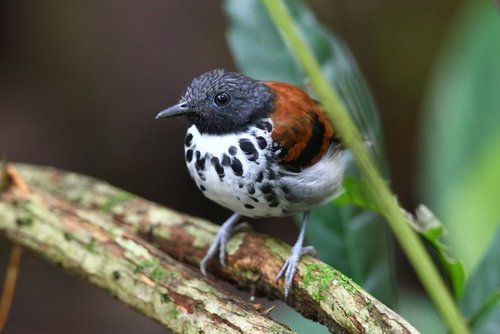
The spotted antbird (scientific name Hylophylax naevioides (Lafresnaye, 1847)) measures 10 to 12 cm (3.9 to 4.7 in) in length and weighs 15 to 19.5 g (0.53 to 0.69 oz). Its two recognized subspecies have very similar plumage overall.
Adult males have a gray forehead, with a grayish brown to olive-brown crown and nape. Their back is chestnut, with a white and chestnut patch located between the scapulae; the white portion of this patch is usually not visible. Their uppertail coverts are dull cinnamon. Their wings are black, with cinnamon-rufous tips on the coverts. Their tail is grayish brown, with cinnamon tips on most feathers (the outermost feathers have pale brown to white tips) and a black band just above the tips. Their lores and ear coverts are gray, while their cheeks and throat are black. Most of their underparts are white, marked with a "necklace" of heavy black spots across the breast. Their sides are gray, their flanks brownish buff, and their undertail coverts pale brownish buff.
Adult females have a dull brown crown and nape. Their back is the same chestnut color as the male's, and also has a hidden white and chestnut interscapular patch. Their wings and tail match the male's pattern and color. The sides of the female's head are blackish slate with pale cinnamon-brown lines. Her throat ranges from white to buff. Most of her underparts are white, with irregular olive or dull gray spots on the breast. Her sides and flanks are olive to olive-buff.
Juvenile spotted antbirds are very similar to adults; juvenile males have grayish feathers on the chest and vent area, while juvenile females have rusty white feathers in these regions.
One subspecies, H. n. capnitis, occurs north of the nominate subspecies. It is found on the Caribbean slope of Honduras, Nicaragua, and Costa Rica, on a small portion of the Pacific slope of northwestern Costa Rica, and on both the Caribbean and Pacific slopes of western Panama. The nominate subspecies occurs on both slopes of central and eastern Panama, in northern Colombia, and extends through western Colombia into western Ecuador as far south as Guayas and Chimborazo provinces.
Across its entire range, this species inhabits humid lowland forest, including both primary forest and mature secondary forest. It favors thick undergrowth in the forest interior. In terms of elevation, it occurs up to 1,000 m (3,300 ft) in Central America and Colombia, but only reaches 300 m (1,000 ft) in Ecuador.