About Hylophilus thoracicus Temminck, 1822
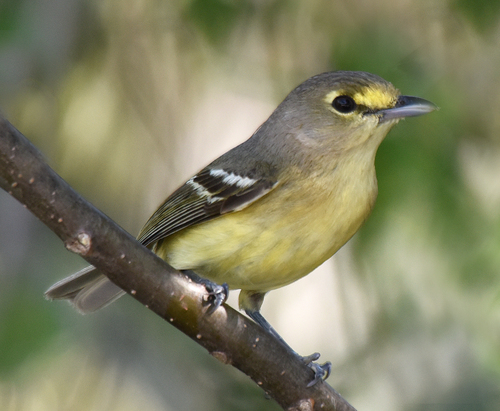
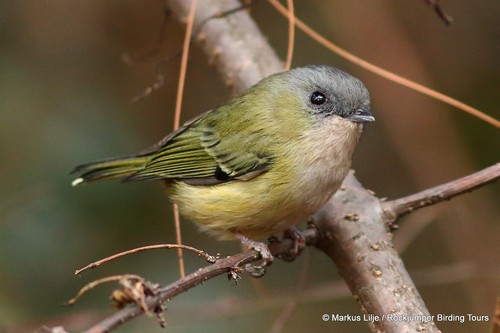
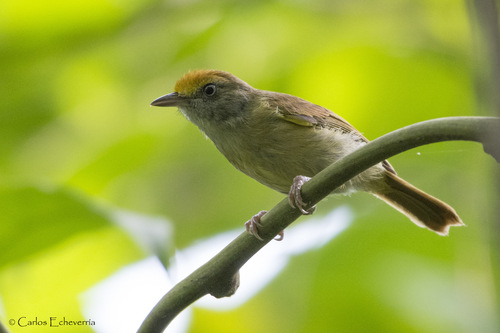
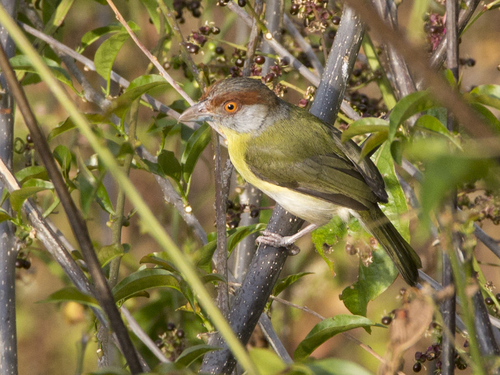
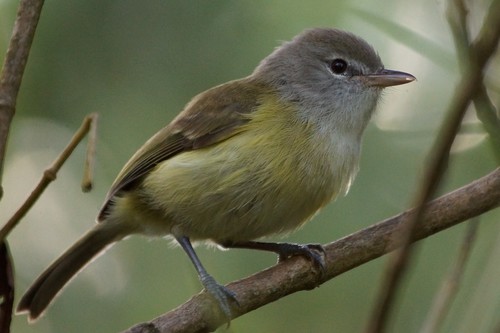
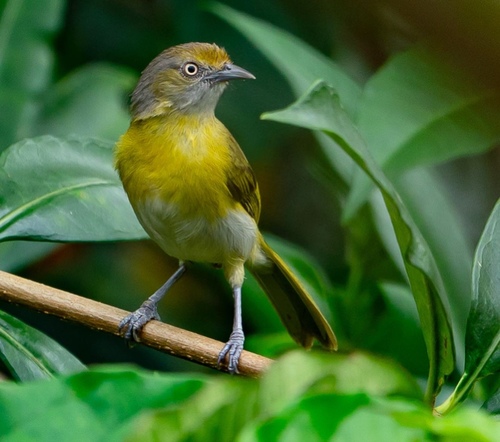
The lemon-chested greenlet (Hylophilus thoracicus Temminck, 1822) measures 10 to 13 cm (3.9 to 5.1 in) long and weighs 11 to 14 g (0.39 to 0.49 oz). Males and females have identical plumage. Adult nominate subspecies H. t. thoracicus have an ochraceous olive forehead, a dull grayish olive crown, and a wide grayish nape collar. Their lores and the sides of the head are grayish, with a greenish tinge on the ear coverts. Their upperparts are bright olive, often with a yellowish tinge. The wing coverts and flight feathers are dull blackish gray, with wide bright olive to yellowish green edges on the flight feathers. Their tail is also dull blackish, with wide bright olive to yellowish green edges on its feathers. Their chin and throat are grayish to grayish white, and their breast is bright yellow. The rest of their underparts are pale creamy buff to whitish, with a variable yellow tinge on the flanks, vent, and undertail coverts. Subspecies H. t. aemulus has less gray on the crown and more buff-colored throat and underparts than the nominate subspecies. H. t. griseiventris has a gray hindcrown, a gray throat, a greenish yellow breast, and gray lower underparts. Juveniles of all subspecies are simply duller versions of adults. Adults of all subspecies have a whitish to bright white iris, which sometimes carries a yellow to pinkish tinge. They have a gray to dark maxilla, a white to pinkish mandible, and gray to pinkish legs and feet. Juveniles have a brown to dark gray-brown iris. The lemon-chested greenlet has a disjunct distribution, with the nominate subspecies completely separated from the other two subspecies. H. t. aemulus is found from extreme southeastern Colombia, intermittently south through eastern Ecuador and eastern Peru, into northern Bolivia. H. t. griseiventris occurs in Bolívar state in eastern Venezuela, east across the Guianas, and across much of northern and central Amazonian Brazil. H. t. thoracicus is found in eastern Brazil, intermittently from southern Bahia south to northeastern São Paulo state. The lemon-chested greenlet lives in a wide range of wooded landscapes, including terra firme, várzea forest, the transitional forest between these two types, gallery forest, restinga, cloudforest, and wooded urban areas. In elevation, it occurs mostly from sea level to 600 m (2,000 ft) in Brazil, reaching higher elevations locally. It reaches up to 500 m (1,600 ft) in Colombia, 400 m (1,300 ft) in Ecuador, 850 m (2,800 ft) in Peru, and 700 m (2,300 ft) in Venezuela.