About Hylophilus ochraceiceps P.L.Sclater, 1860
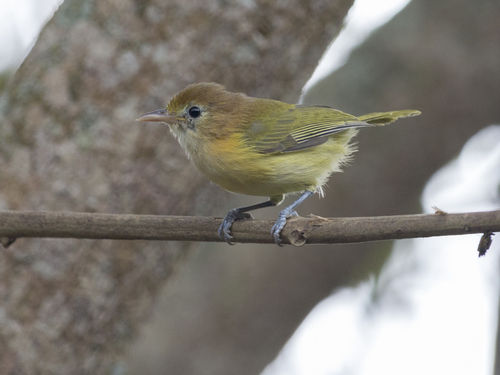
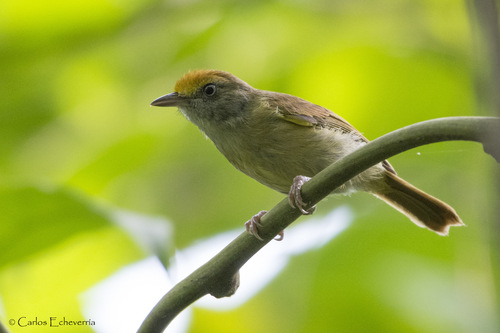
The ochre-crowned greenlet, scientifically named Hylophilus ochraceiceps P.L.Sclater, 1860, measures 9.5 to 13 cm (3.7 to 5.1 in) long and weighs 8.4 to 13.5 g (0.30 to 0.48 oz). Males and females have identical plumage. Adults of the nominate subspecies H. o. ochraceiceps have a yellowish forehead and yellow-brown crown, with a mostly dull grayish face. Their upperparts are olive-brown, with a slightly more greenish tone on the rump. The primary and secondary feathers of their wings are grayish black, with buff-brown edges along the outer webs. Their tail is dull brown, with cinnamon-brown edges on each feather. Their chin is mottled grayish white, their throat is gray with a faint yellow-green tinge, their breast is ochraceous, their flanks are yellowish gray, the center of their belly is yellow, and their vent is grayish yellow. Their underwing coverts are yellow. They have a pale gray iris, a gray upper mandible (maxilla), a paler lower mandible, and pinkish to grayish legs and feet. Other subspecies of the ochre-crowned greenlet differ from the nominate subspecies and one another in the following ways. H. o. pallidipectus has a paler throat and paler underparts than the nominate, with a pale buffy breast, grayer flanks, and pale yellow underwing coverts. H. o. pacificus has darker gray throat and darker gray underparts than pallidipectus, with little or no yellow on the belly, brownish gray flanks, and pale yellow underwing coverts. H. o. nelsoni has a tawny forehead and crown, olive-greenish upperparts with an olive-brown middle back and olive-brown wing coverts, and pale dingy greenish yellow underparts. H. o. bulunensis has darker olive-green upperparts than the nominate, with bright greenish yellow underparts. The ochre-crowned greenlet is a permanent year-round resident. Its range extends from southern Mexico through Central America to the Pacific coast region of Colombia and northern Ecuador. It lives in low-altitude humid evergreen forests, from sea level up to 1,300 m (4,300 ft). In Costa Rica, it inhabits mature wet forest up to 1,300 m (4,300 ft). Field guides for Colombia record the species in humid forest, up to 800 m (2,600 ft) in Colombia, and mostly below 700 m (2,300 ft) in northern Ecuador.